

Shimano’s Ultegra 6700 groupset is a 10-speed road bicycle component set that debuted around 2009 as the successor to Ultegra 6600. Renowned as the trickle-down version of pro-level Dura-Ace 7900, Ultegra 6700 delivers high-performance shifting and braking at a friendlier price point. In this overview, we’ll cover Ultegra 6700’s historical context, a detailed breakdown of its components, comparisons with other Shimano and rival groupsets, real-world impressions, maintenance tips, and a conclusion on its value for today’s riders.
Looking Back at a 10 Speed World
Ultegra 6700 was announced in 2009 for the 2010 model year, marking a significant evolution in Shimano’s mid-high tier road lineup1. It replaced the prior Ultegra 6600 (and the lighter 6600 “SL” variant) and continued Shimano’s tradition of trickling down Dura-Ace technology to more affordable groups. In fact, the 6700 series borrowed many features from the then-new Dura-Ace 7900 and shed considerable weight compared to 6600: about 150g lighter than the standard 6600, and even 44g lighter than 6600SL2.
Chronologically, Ultegra sits one step below Dura-Ace (Shimano’s flagship pro-level group) and above 105 in the Shimano road hierarchy3. In the late 2000s, Shimano’s lineup from entry to top was roughly: Tiagra (entry-level 9-speed at the time), 105 (10-speed, more budget-friendly), Ultegra (10-speed, enthusiast level), and Dura-Ace (10-speed, professional grade). Ultegra began life as “Shimano 600” in the 1980s before being renamed; by the 6700 series, it had firmly established itself as a full-fledged racing component line, often used by amateur racers and even as backup equipment for pros4. After Shimano launched Ultegra 6700, they followed up in 2011 with Ultegra 6770, an electronic Di2 version, bringing electronic shifting to Ultegra for the first time4.
Ultegra 6700’s development was driven by the cycling trends of its era: a push for more ergonomic, aerodynamic design, lighter weight, and seamless integration with modern frames. It adopted many of the innovations that Shimano had premiered in Dura-Ace 7900, aiming to deliver “pro-level” performance to a broader audience. As Shimano described it, the 6700 series became “more racing oriented in terms of functions and design,” essentially raising the bar for what a second-tier groupset could do4.
Importantly, Ultegra 6700 was Shimano’s last Ultegra generation to use a 10-speed drivetrain. It bridged the gap between the traditional 10-speed era and the later move to 11-speed with Ultegra 6800 in 20134. This context is key when examining compatibility and longevity – 6700 parts are cross-compatible with other Shimano 10-speed road components (105 5700, Dura-Ace 7900, etc.), but not directly with newer 11-speed systems.
Ultegra 6700 Parts List
Ultegra 6700 is a complete groupset, including shifters (STI levers), front and rear derailleurs, crankset, bottom bracket, brakes, cassette, and chain. Each component saw notable upgrades from the previous generation. Below is a detailed look at each part, its technical specs, and design innovations:
Shifters (ST-6700 Dual Control Levers)
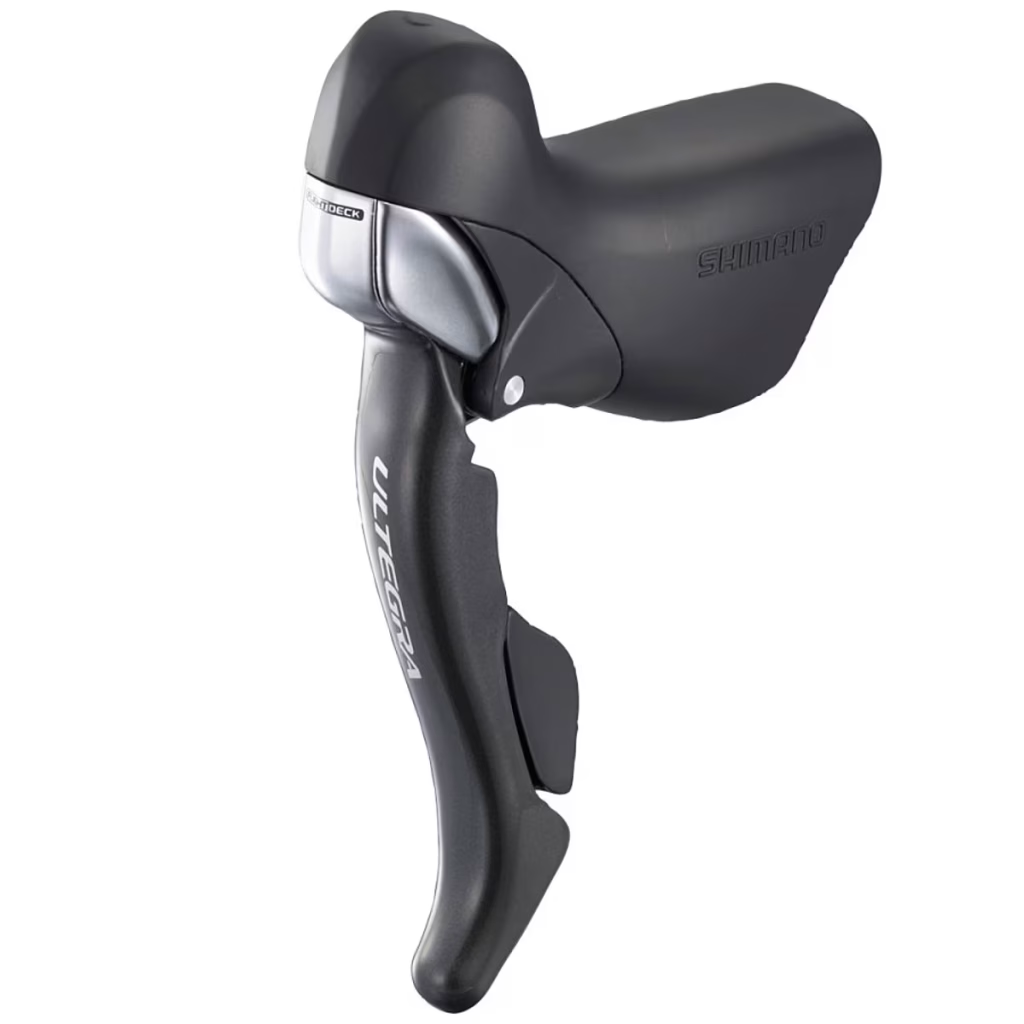
Shimano Ultegra ST-6700-L Left/Front Rim Brake Shifter
Price range: $120.00 through $300.00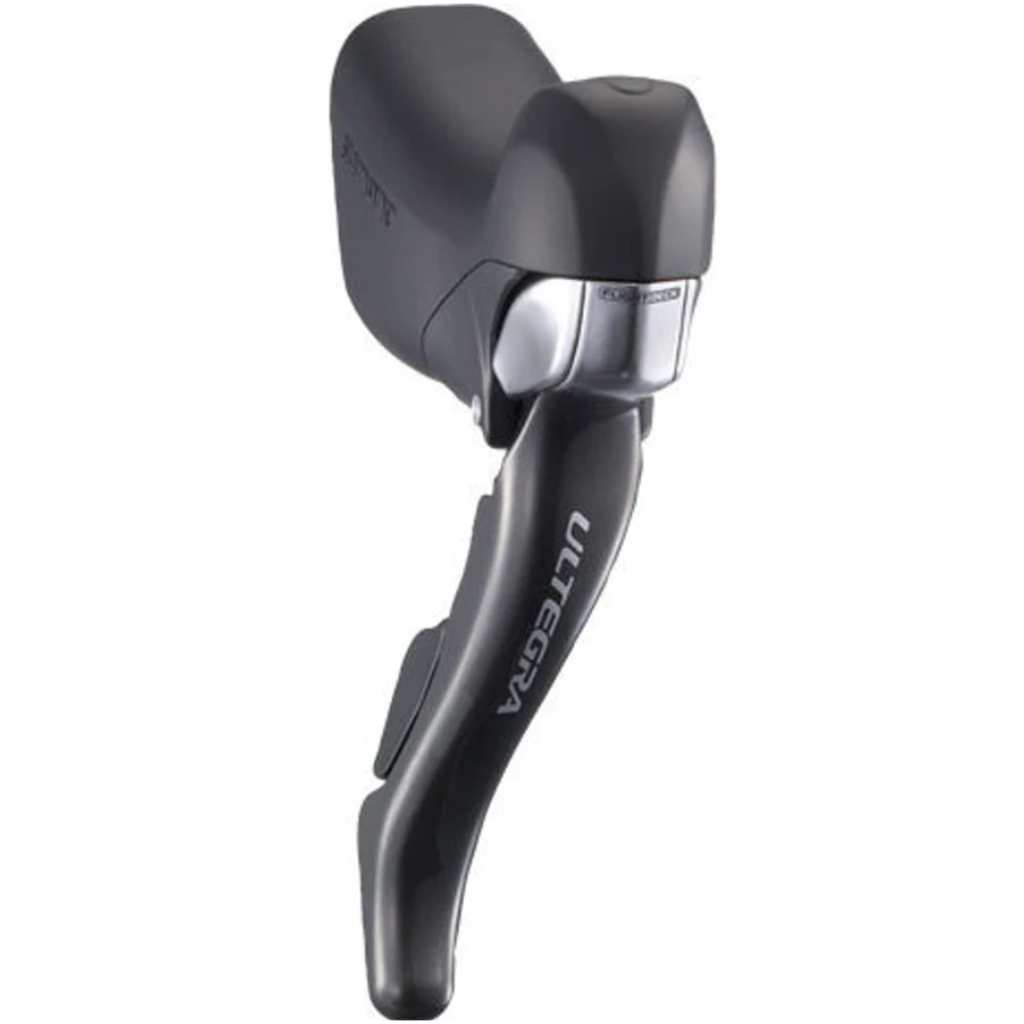
Shimano Ultegra ST-6700-R Right/Rear Rim Brake Shifter
Price range: $140.00 through $350.00
The Ultegra ST-6700 dual control levers (shifter/brake lever units) were heavily redesigned for 6700. Most visibly, Shimano moved to hidden cable routing – the shift cables now run under the bar tape (like Dura-Ace 7900 did) instead of looping out of the lever. This gives a cleaner, more aero cockpit and was a first for Ultegra1. The lever shape itself became more compact with a higher hood position, mirroring the ergonomic trends set by rival designs. Testers noted that the hood shape and size hit a sweet spot between previous chunky Shimano hoods and slimmer Campagnolo-style hoods5, making for a comfortable grip for various hand sizes. Shimano also added a reach-adjust mechanism via shims, allowing riders with smaller hands or shorter reach to dial in the brake lever position1.
Another innovation was the use of carbon fiber lever blades on Ultegra 67001. The carbon levers helped shave a few grams and gave Ultegra a touch of high-end material usually reserved for Dura-Ace. (Previous Ultegra generations had aluminum lever blades.) Each lever weighs roughly ~222g (claimed ~445g for the pair)2, a minor weight reduction over 6600. Internally, the shifter mechanism was tweaked to accommodate the new cable path and to maintain Shimano’s signature indexed shifting feel. Shifting through the 10-speed cassette remains light and positive, though some riders observed that the under-tape cable routing can introduce a bit more friction if housing isn’t perfectly set up6(more on that in Maintenance).
Notably, Shimano adjusted the lever pivot location to improve braking leverage when riding on the hoods2. This was part of a new Super SLR design to deliver stronger braking power from the top of the hoods. In practice, reviewers found braking from the hoods on 6700/7900 to be markedly more powerful and responsive than previous generations7. Overall, the ST-6700 units brought Ultegra fully up to date with modern ergonomics: hidden cables, carbon leverage, adjustable reach, and an excellent blend of comfort and control.
One thing to be aware of is compatibility: Shimano engineered these levers as part of the 6700/7900 ecosystem. They will physically work with older 10-speed derailleurs (e.g., Ultegra 6600 or Dura-Ace 7800), but Shimano labels that “B-level” compatibility (not optimal)7. The pull ratios for brakes and front shifting were tweaked (slightly different cable pull and lever throw), so for best performance the ST-6700 levers should be paired with 6700/7900 derailleurs and brakes7. We’ll discuss more on mix-and-match possibilities in the maintenance section.
Front Derailleur (FD-6700)

The Ultegra 6700 front derailleur carried several subtle but important improvements. It features a wider inner linkage design, which boosts rigidity of the derailleur cage. This extra stiffness helps translate shift commands into quick, crisp chain movement up or down the chainrings. In fact, Shimano claims the FD-6700’s broad linkage makes the whole structure much stiffer and more positive in shifting feel5. Reviewers noticed that front shifts were very reliable under load – even when shifting to the big ring while sprinting or climbing out-of-saddle, the FD-6700 could execute the shift without hesitation or chain rub5.
Another tweak was reduced spring tension: FD-6700’s return spring is about 10% lighter than the older 6600 unit2(making it easier to actuate). That, combined with refined cage geometry, means less force is needed at the lever to shift, and the shift action “feels” lighter. Shimano also slightly widened the gap between the two cage plates on the double front derailleur, by roughly 1mm5. This was done to allow more cross-chain freedom (so you can use a wider range of rear cogs in the big ring without rubbing the front derailleur cage). Because of this change, Shimano offered dedicated double vs. triple front derailleur designs (and separate left shifters to match) for 6700. The double front derailleur is optimized for the new spacing, while the triple version is for 3×10 setups. Older generations had more interchangeability, but in 6700 a double front shifter won’t perfectly index a triple derailleur due to the different cable pull and gap.
The FD-6700 was available in braze-on mount or clamp-band, and in two variants for double or triple cranksets. It’s designed to handle the standard double chainring difference (e.g. 50/34 compact or 53/39 standard) or a triple (52/39/30). Weight is quoted at about 89g for the braze-on double FD2, a few grams lighter than the prior generation thanks to some trimming of material at no cost to stiffness.
In terms of compatibility, as mentioned, the FD-6700 works best when paired with ST-6700 shifters because the leverage and indexing were tuned as a system. It can be used with older 10-speed STI levers (5600/6600), but you may not get the same crispness or you might need to use the trim positions differently7. One nice feature retained in Ultegra (unlike Dura-Ace 7900) is the trim function – you still get a trim click on the small ring side to eliminate chain rub5. While Dura-Ace 7900 infamously removed most trim, relying on precise setup instead, Ultegra 6700 gives you a bit more leeway with that inner chainring trim, which home mechanics appreciate during fine-tuning.
Rear Derailleur (RD-6700)
The Ultegra 6700 rear derailleur also saw refinements aimed at improving shift precision and expanding gear range capacity. Like the front derailleur, the link pivots were widened on the RD-6700 to reduce flex1. A stiffer derailleur body means more consistent indexing as you click through the cassette, especially under load. Test riders generally reported that the 6700 rear shifting felt “snappier” and more authoritative than the 105-level RD-5700, for example, likely due to these build upgrades6.
The RD-6700 came in two cage lengths: Short Cage (SS) and Medium Cage (GS). The short cage version is intended for double chainring setups and can accommodate cassettes up to 28T large cog (10-speed 11-28 cassette is within spec)2. This was an increase over some older Ultegra models which officially topped out at 27T. The medium cage “GS” model is designed to handle the triple crankset’s extra chain wrap and could take an even larger cassette (often up to 32T with the right setup, though Shimano’s documentation at the time was conservative about officially listing 30T for triples). Essentially, Ultegra 6700 made it easier to run wide-range gearing – useful for riders who wanted lower climbing gears.
Materials-wise, the outer pulley cage on the RD was made of a composite (carbon fiber reinforced) material in Ultegra 67002. This again saved a bit of weight compared to prior models, with the RD-6700 SS weighing in at about 190g2, roughly 10g lighter than the 6600 edition, which used more alloy/steel. The finish on Ultegra derailleurs is a polished or glossy gray anodized alloy; but not quite as finely polished as Dura-Ace 7900’s shiny finish2. But functionally, the Ultegra rear mech delivered near-identical performance to its Dura-Ace counterpart, just at a small weight penalty.
It’s worth noting that RD-6700’s cable pull and indexing are matched to 10-speed Shimano shifters. If you use ST-6700 levers, it’s a perfect pair. If someone tried to use an 11-speed shifter with this RD, it wouldn’t index correctly (and vice versa) because the actuation ratio changed with 11-speed. Within the 10-speed world, RD-6700 can swap in for a 105 or Dura-Ace rear derailleur with no issues, though Shimano did designate Dura-Ace 7900 and Ultegra 6700 as “A compatible” with each other, and older 7800/6600 as “B” (meaning slightly different pulley alignment but generally workable)7.
Crankset (FC-6700/6750) and Bottom Bracket (SM-BB6700)
The Ultegra 6700 crankset was one of the most visible changes in the groupset, adopting a radically new look and construction inspired by Dura-Ace. The crank uses Shimano’s Hollowtech II technology just like the prior Ultegra: hollow forged aluminum crank arms with an integrated oversized steel spindle. But new for 6700 was the adoption of the Hollowglide outer chainring design14. This means the large chainring (e.g., the 50T or 53T ring) is actually a hollow structure, made by bonding two thin aluminum plates together to form a stiff but lightweight ring. Previously, this was seen only on Dura-Ace. The benefit is a chainring that is lighter yet maintains high rigidity for precise shifting. The attachment method is also neat: the chainring bolts on the 6700 crank pass through only the inner chainring and thread into the back of the hollow outer ring, giving the appearance of a one-piece chainring/spider from the outside7. This design is part functional, part aesthetic; it eliminates the visible bolt heads on the front for a clean look.
The crankset was offered in standard (130 BCD, typically 53/39T rings), compact (110 BCD, 50/34T rings, designated FC-6750), and even a triple (FC-6703, usually 52/39/30T). Crank arm lengths available were 165mm (in some markets), 170mm, 172.5mm, and 175mm for double; unlike Dura-Ace, Ultegra did not offer more unusual lengths like 167.5 or 180mm7. Shimano did not produce an official BB30 or press-fit specific Ultegra crank; instead, if your frame was BB86/BB90, you’d use adapters or Shimano-supplied press-fit bottom brackets to fit the 24mm spindle7. So the Ultegra crank remained on the tried-and-true outboard bearing system, which many appreciated for its reliability.
In terms of weight, the Ultegra 6700 crankset (standard double, 170mm) has a claimed weight around 785g including chainrings2, about 15g lighter than the previous Ultegra SL crank1. It’s still heavier than Dura-Ace 7900’s crank by roughly 60-70g, mainly due to material differences. But impressively, the Ultegra crank is forged from the same mold as Dura-Ace 79007, meaning the overall shape and structural design are identical. In use, riders and reviewers found the FC-6700 crankset to be extremely stiff and efficient. Multiple tests remarked that it was “as stiff as any” crank out there5. Even under powerful riders, there was negligible flex; the benefit of that beefy Hollowtech II arm and the hollow outer ring is smooth, immediate power transfer7. Shifting between rings is also excellent; the ramps and pins on the rings, combined with the stiff rings, produced quick, reliable shifts. One reviewer enthused that even hard shifts under full power did not faze it: “not a single miss” during deliberate torture testing of shifting while mashing the pedals5.
The bottom bracket for Ultegra 6700 (SM-BB6700) also got a small upgrade: improved seal design to reduce friction7. Shimano mentioned they redesigned the seals to lower drag, aiming to spin a bit freer, while keeping durability. The BB still uses steel cartridge bearings in cups that thread into a standard English or Italian bottom bracket shell. Many users report long life from Shimano external BBs, and Ultegra’s is no exception: it’s considered a very affordable and easily replaceable item if it ever wears out7. In practice, BB6700’s life is similar to the prior generation; some riders upgrade to Dura-Ace BBs for a tiny bit less friction or to third-party ceramic units, but that’s more luxury than necessity.
One word on the Ultegra chainrings: because of the Hollowglide construction, the replacement cost for the big ring can be high (similar to Dura-Ace). Early reports noted the Dura-Ace 7900 big ring was extremely expensive to replace (>$300), and while Ultegra’s is cheaper, it’s still a costly part of the crank7. The good news is that the rings are very durable; unless you put huge mileage or ride in poor conditions without maintenance, it’s rare to completely wear out a large chainring. So, for most users, the rings last a long time, making that a theoretical concern more than a frequent expense.
Brakes (BR-6700 Dual-Pivot Calipers)
The Ultegra BR-6700 brake calipers saw a redesign focused on improving braking power and modulation, especially when paired with the new levers. Visually, the calipers have a slightly tweaked arch shape and smaller sized hardware compared to 6600. Shimano introduced a new pivot location (often dubbed New Super SLR design) which effectively makes the caliper pull about 20% more cable for a given amount of lever movement7. This was done by altering the geometry of the caliper’s arms and the lever’s actuation. The result is significantly improved braking force, particularly when squeezing the brakes from the top of the hoods7. Testers noted that Ultegra 6700 brakes felt more powerful and predictable, matching the best brakes on the market at the time7. From the drops or the hoods, the modulation is excellent: you get a strong bite without harsh grab, allowing confident feathering of speed.
In terms of construction, Ultegra brakes continue to use forged aluminum arms, with steel hardware for most bolts. Dura-Ace calipers use some titanium hardware to save weight, which is why Ultegra’s pair is about 20g heavier (Ultegra BR-6700 ~317g vs Dura-Ace 7900 ~296g per pair)7. Otherwise, the design and materials are very similar to Dura-Ace. Shimano even used the exact same brake pad compound in Ultegra 6700 as in Dura-Ace 79007. These pads were a new formulation that Shimano claimed offered 100% more braking power in wet conditions and 20% more in dry vs. previous pads25. Users generally found the wet-weather braking indeed improved with these new pads (though “100% more” is hard to verify, they were certainly better). The pads sit in standard cartridge holders, so they are easy to replace with any Shimano-style insert.
Another nice feature: adjustable spring tension and a multi-position quick release on the caliper5. The tension adjuster lets you fine-tune how hard the lever feels (if you prefer snappier return or a lighter feel). The quick release lever on BR-6700 has multiple detents – you can open it partially or fully, which helps if you just need a tiny bit more clearance for slightly wider tires or a wheel with a minor wobble. With it fully open, wheel removal is easy even for 25-28c tires. This was a small but welcomed usability improvement, reducing the need to deflate tires just to squeeze a wheel out.
It’s important to reiterate compatibility: the BR-6700 calipers achieve their best performance when paired with ST-6700 or ST-7900 levers. The new Super SLR geometry means if you use these calipers with older levers (e.g., 105 5600 or Ultegra 6600 levers), you’ll experience a mismatch in leverage: the braking may feel spongy or require more lever throw, since those levers pull less cable. Shimano cautioned against mixing new and old brakes for this reason7. In fact, aside from one specific cyclocross cantilever model (BR-CX70/BR-550), virtually no other brakes on the market at the time had the exact pull ratio that ST-6700 levers were designed for7. Some riders discovered that if you tried using 6700 levers with older cantilevers or brakes, the increased cable pull resulted in a very powerful but sudden brake feel (sometimes too grabby for cantis). Thus, if you upgrade one, it’s wise to upgrade the matching part. Ultegra 6700’s brakes + levers as a set, however, are stellar. Some people may even consider building Dura-Ace bikes with Ultegra calipers installed to save money with almost no performance loss7.
Cassette (CS-6700)
The Ultegra CS-6700 cassette is a 10-speed cassette offered in a variety of road ratios. Available gear ranges included 11-23, 12-23, 12-25, 11-25, and 11-28.2. Shimano slightly revised the cassette design from the prior 6600: the spider carrier for the largest sprockets was updated and some steel sprockets were re-profiled to reduce weight a bit. For example, an 11-23T Ultegra 6700 cassette is claimed about 208g2, a small reduction from the older Ultegra which was ~10g heavier. In general, Ultegra cassettes feature the largest 3-4 cogs mounted on an alloy carrier, which cuts weight and also protects aluminum freehub bodies from getting notched by individual sprockets. The smaller cogs are individual nickel-plated steel, with Shimano’s Hyperglide ramps for smooth shifting.
Performance-wise, the Ultegra cassette shifts extremely well, essentially on par with Dura-Ace, just a touch heavier due to materials. Dura-Ace 7900 cassettes use titanium for the largest cogs to save weight, whereas Ultegra sticks to steel throughout. The gear combinations Shimano offered recognized that many riders were embracing wider ranges; the inclusion of an 11-28T option meant Ultegra users could get genuinely low climbing gears when paired with a compact crank. Previously, one might have had to use an MTB cassette or 3rd-party for a 28T+ cog on Ultegra 10-speed; 6700 made it standard.
The cassette attaches to any Shimano 10-speed splined hub body (or SRAM 10-speed, since the spline standard is shared). This means if you had wheels from the 9/10-speed era, they were ready to accept Ultegra 6700 cassettes with no issues. It’s not compatible with 11-speed freehubs unless you use a spacer. Since 11-speed freehub bodies are wider, a 10-speed cassette would need a 1.85mm spacer to fit snugly.
In summary, the cassette doesn’t introduce radical new tech, but it complements the groupset by being slightly lighter and continuing Shimano’s legacy of very smooth shifting cassettes. Many riders mix and match Ultegra cassettes on Dura-Ace setups or vice versa with no problems: the shifting precision comes more from the derailleur and shifter design, and Ultegra cogs provide crisp indexing and durability.
Chain (CN-6700/CN-6701)
Even the chain saw some redesign for Ultegra 6700. The CN-6700 chain is a 10-speed directional chain, meaning it has an “inside” and “outside”. It must be installed in the correct orientation for optimal shifting. Shimano engineered the outer plate profile vs inner plate profile differently: the outer plates (which face the chainrings) are shaped to engage ramps/pins on chainrings better, while the inner plates (facing the cassette cogs) are shaped to climb the cassette ramps more smoothly5. Therefore, when installing, the chain’s logos stamped on the outer plates should face outwards. If installed in reverse, it will still run, but shift quality and drivetrain noise may suffer.
The chain also features perforated (hollow) inner plates to reduce weight by a few grams5. Shimano claimed about an 8g savings from the hole drilling, with a full chain weighing around 267g (114 links)2. Ultegra chains have a nickel-plated finish for corrosion resistance and typically come with Shimano’s standard connecting pin.
Functionally, the Ultegra 6700 chain runs quietly and shifts very well, as it’s essentially the same design as the top-tier Dura-Ace 7900 chain, with just a tiny weight difference (Dura-Ace chains used hollow pins as well to save a few more grams). The asymmetrical plate design was fairly new in this era and did improve shifting under load. Longevity of CN-6700 is typical of high-grade 10-speed chains; many users report getting around 3,000-5,000 km per chain with proper maintenance, which is on par with other 10-speed chains.
In sum, Ultegra’s chain complements the whole 6700 groupset to ensure that all those ramps, pins, and shift assists on the cassette and chainrings are utilized fully. It’s a classic example of Shimano’s system engineering: each piece is optimized in tandem with the other components.
Shimano Comparison
Ultegra 6700 was part of Shimano’s 2010 lineup, flanked by 105 (5700 series) below it and Dura-Ace (7900 series) above it. All three groups were 10-speed and shared many DNA traits, but they targeted different audiences and price points. Here’s a comparison of these three Shimano groupsets from the same generation:
| Shimano 105 5700 (10‑speed) | Shimano Ultegra 6700 (10‑speed) | Shimano Dura‑Ace 7900 (10‑speed) | |
| Position in Line | Mid‑level / entry racing | High‑end enthusiast / semi‑pro | Professional flagship |
| Introduction Year | ~2010 | 2010 model year | Late 2008/2009 |
| Shifters | Internal cables, alloy levers | Internal cables, carbon lever blades, reach adjust | Internal cables, carbon blades, refined internals |
| Derailleurs | Steel/aluminum mix | Wider pivots (stiffer), composite cage | Max stiffness, carbon/aluminum, Ti hardware |
| Crankset | Hollowtech II arms, solid rings | Hollowtech II, Hollowglide hollow outer ring | Hollowtech II, Hollowglide ring, Ti bolts |
| Brakes | Dual‑pivot, new SLR design | Dual‑pivot, Super SLR, steel hardware | Dual‑pivot, Super SLR, Ti hardware |
| Cassette | All‑steel, ~250 g (11‑28) | All‑steel, ~208 g (11‑23) | Ti/steel, ~175 g (11‑23) |
| Chain | 10‑speed, directional | 10‑speed, hollow plates (~267 g) | 10‑speed, hollow plates & pins (~255 g) |
| Complete Group Weight | ~2,500+ g | ~2,301 g | ~2,180 g |
| MSRP | $700-800 | $1,300-1,500 | $2,300+ |
The table highlights how Ultegra 6700 weighs only ~120g more than Dura-Ace 7900 for the whole groupset7, a testament to how much of Dura-Ace’s design was inherited. Ultegra achieves this by using slightly heavier materials (e.g., steel where Dura-Ace uses titanium, some aluminum where Dura-Ace might use carbon), but functionally they are very close. 105, on the other hand, weighs a few hundred grams more than Ultegra, largely due to less exotic materials (e.g., 105’s crank doesn’t have the hollow chainring, its cassette has no titanium, and its shifters use aluminum instead of carbon).
All three are index-shifting Shimano systems and thus have the same fundamental feel of multiple clicks and trim as needed. However, Ultegra and Dura-Ace have a lighter and more precise feel compared to 105. Some riders describe 105’s shifting as a tad more “grainy” or requiring a firmer push, whereas Ultegra 6700 “snaps into gear with more authority”6. This can be attributed to stiffer derailleurs and lower cable friction in Ultegra. Dura-Ace 7900 was actually somewhat controversial: early reviews noted that Dura-Ace 7900’s mechanical shifting was finicky to adjust and could be noisy7, possibly because it was so tightly tuned or due to manufacturing tolerances. Interestingly, some reviewers felt Ultegra 6700 was more refined than first-gen 7900 in terms of setup and noise, calling Ultegra “almost more of a polished, finished product” than the initial Dura-Ace 79007. In practice, all three (105, Ultegra, Dura-Ace) can shift excellently when properly adjusted, but Ultegra just hits a sweet spot of a very forgiving setup with near-top performance.
With the new hidden-cable lever design, both 105 5700 and Ultegra 6700 gained much stronger braking when paired with the matching calipers. Ultegra’s brakes, having the slight hardware edge, were measured about 21g lighter as a set than 105’s brakes and offered a bit more smoothness. Dura-Ace’s brakes shaved another ~20g and had titanium bits, but power and modulation wise, Ultegra 6700 and Dura-Ace 7900 brakes feel almost identical7. Like mentioned before, you could swap Ultegra calipers onto a Dura-Ace bike and hardly notice a difference anywhere other than your wallet.
Shimano clearly positioned Ultegra to be the value alternative to Dura-Ace. At roughly 40-50% the cost of Dura-Ace, Ultegra 6700 delivered ~90-95% of the performance (with a small weight penalty). This made it extremely popular for racers who aren’t backed by sponsorship. In fact, even some pro teams have historically spec’d Ultegra components on race bikes to save budget or for training bikes5. Meanwhile, 105 was significantly cheaper than Ultegra (often half the price), making it the choice for entry-level racing bikes and enthusiast road bikes. 105 offers solid performance but for those who demanded sharper, lighter components, the upgrade to Ultegra 6700 was noticeable and often worth the cost. As one road.cc verdict put it, Ultegra 6700 is “the smart choice, performs like Dura-Ace but costs less and weighs a tad more”8– neatly summarizing its place in Shimano’s lineup.
Although not in the same 10-speed series, it’s worth mentioning Tiagra sat below 105 and was 9-speed at the time (Tiagra later became 10-speed in its 4700 series). Tiagra 4600 in 2010 lacked the under-bar tape cables and had heavier, more basic construction. So Ultegra was two tiers above, with a huge performance gap in feel and tech. By contrast, the gap between Ultegra and Dura-Ace had become quite small by 2010, mostly a matter of diminishing returns for weight and bling.
Ultegra 6700 stands in the middle ground: significantly more refined than 105 5700, and nipping at the heels of Dura-Ace 7900. For most non-pro riders, Ultegra offered the best balance of cost vs. performance in Shimano’s lineup, which is why it earned a reputation as a workhorse racing groupset.
Competitor Comparison
When Ultegra 6700 launched, its natural competitors were SRAM’s Force (and to some extent Rival) and Campagnolo’s Chorus (and Athena) groupsets. These were each company’s roughly equivalent tier: second-from-top for SRAM (Force was just below Red) and third-tier for Campagnolo (Chorus below Record and Super Record). Each brand had its own design philosophy, offering a different feel and feature set. Here’s how Ultegra 6700 stacked up against its rivals:
Shifting Mechanism
This is the most obvious difference. Shimano uses the Dual Control lever – one lever for braking, plus a big lever and a smaller inner lever for shifting (two separate shift levers per side). SRAM uses DoubleTap – one single lever per side that you tap lightly for upshift and press further for downshift. Campagnolo uses ErgoPower levers – one upshift lever behind the brake lever and a separate thumb lever on the inside for downshifts. The result is each system has a unique feel:
Shimano Ultegra 6700
Smooth, linear shifting with clearly indexed clicks. You can typically shift up the cassette up to 2 cogs at once with one long sweep of the lever, and downshift one cog per click with the small lever. Shimano’s system by this time was well-honed; shifts are very consistent and it’s easy to trim the front derailleur as needed. The lever throw (distance) for Ultegra 6700 was moderate; not as short as later 11-speed, but not overly long either.
SRAM Force (2010 era)
A “crisper” feel with more tactile feedback. Reviewers often noted that Force’s shifts feel snappier, with a bit more of a pronounced click/clunk into gear7. SRAM had revised Force’s DoubleTap by 2010 to reduce the lever throw significantly (from 32° down to 15° for a full shift)7, so by this generation Force’s shifting was very quick. DoubleTap doesn’t allow multiple shifts in one motion (you do one gear at a time) but the action is light and direct. SRAM also provided a trim for the front derailleur (on the small ring) and added reach adjust to their levers by this time7. Some riders love the single-lever simplicity of DoubleTap; others prefer separate levers. It’s largely personal preference.
Campagnolo Chorus (2010 era 11-speed)
Campy’s Ergopower levers have a distinct feel, often described as “mechanical” and positive. You can shift multiple cogs in one sweep: up to 3 cogs bigger (downshifting with the thumb lever) and up to 5 cogs smaller (upshifting with a long sweep of the lever) in one go. This was a hallmark of Campagnolo, appealing to riders who want to dump gears rapidly (e.g., a sudden sprint or climb). Chorus in 2010 was actually 11-speed, which gave it a slight tech edge in gearing steps. The shifting action typically requires a bit more finger force and has a firmer click than Shimano: you know when you’ve shifted by the pronounced feedback. Some riders adore this, saying “you know which cog you’re on by touch” due to the distinct clicks9. Ergonomically, Campy’s hood shape was slim and curved, which some find very comfortable, though the thumb lever can be hard to reach from the drops for people with smaller hands.
Drivetrain Feel
All three systems shift well, but their “feel” and sound differ. Shimano’s Ultegra is often praised for its near-silent operation and smoothness – it’s very refined. SRAM’s Force tends to make a bit more chain noise, and shifts are louder (some might call it a satisfying ker-chunk). Campagnolo’s drivetrain often has a reputation for running very quietly and efficiently once tuned, and the chain can feel slightly “tighter” on the cogs due to Campy’s specific cog profile. In terms of front shifting, Shimano’s engineering usually reigns supreme – Ultegra’s front shifts are extremely smooth and require little effort. SRAM Force front shifting improved by 2010 but still typically needed a bit more lever force and had more noticeable trim steps; Force had a half-step trim on the small ring to allow cross-chaining7. Campagnolo’s front shifting on Chorus was quite good, and Campy allows multiple upshifts (you can move the chain from small to big ring in one sweep if desired). However, historically Campy front shifting can be a tad more abrupt – some riders feel Shimano’s ramps/pins make the chain glide up more gently.
Other Aspects
Weight
By numbers, SRAM Force was the lightest of the three, with a full group weight even a bit below Ultegra. Force crank arms are carbon fiber, the cassette has some alloy carrier, and SRAM tends to aggressively trim weight. For example, Force’s brake calipers were essentially the same as SRAM’s Red calipers (just different hardware) and are lighter than Ultegra’s7. Users building sub-7kg bikes often mixed SRAM Force/Red to shed grams (Force levers and derailleurs are very light). Campagnolo Chorus 11 was roughly on par with Ultegra in weight – Chorus had carbon crank and lever, but also an extra sprocket and some steel in mid-tier (Record/Super Record use more titanium). Many weight weenies would mix Chorus with Record parts to optimize. Ultegra 6700, while not the lightest, was still quite reasonable and only ~120g off Dura-Ace7, making it competitive. In practice, differences of 100–200g between these groups were not felt on the road, but mattered to racers counting grams.
Price
Back in 2010, MSRP for a full Ultegra 6700 was around $1,400-1,5007. SRAM Force was similar, about $1,300-1,400 (and SRAM often bundled different BB options). Campagnolo Chorus was typically a bit higher, perhaps in the $1,600-1,800 range (Campy has always been a bit premium in price, and the 11-speed tech added cost). Street prices varied, but Shimano had the advantage of very widespread availability and often better OEM pricing on bikes. Many mid-range racing bikes came stock with Ultegra, whereas SRAM Force was common on Rival/Force mixed builds, and Campy Chorus was usually found on European brands or high-end custom builds due to brand preference.
Compatibility
This is key for those who mix components. Ultegra 6700 (and any Shimano 10s) is cross-compatible with SRAM 10s for cassettes and chains. You could run a SRAM cassette or chain with Ultegra and vice versa, as they share the same 10-speed spacing. Campagnolo 10 or 11 speed, however, is different; Chorus 11-speed has unique cassette spacing and requires Campagnolo-specific freehub bodies on wheels. So, if one had wheels, the hub compatibility might sway choices: Shimano/SRAM freehub vs. Campagnolo freehub. Also, if you wanted to use say, a Quarq or other third-party crank, it might mesh differently (though chainrings are generally compatible across 10-speed systems; 11-speed Campy chainrings wouldn’t love a Shimano 10s chain as perfectly).
Reputation & Riding Experience
Each groupset has its fanbase. Ultegra was known for bulletproof reliability – “Shimano is reliable,” as one blogger put it bluntly9. You could ride Ultegra hard and it would stay in tune and not be fussy. SRAM Force earned a reputation for being “inexpensive and with DoubleTap” simplicity9, and riders who liked a very firm, positive shifting often enjoyed SRAM’s feel. SRAM’s early drawback was front shifting, but by 2010 Force was much improved and nearly on par. Campagnolo Chorus carried the heritage appeal – “black, elegant” carbon aesthetics and the prestige of the Italian brand9. Campy also had a reputation for longevity and rebuildability; for instance, Ergopower levers could be rebuilt with new g-springs and internals, something Shimano STI couldn’t offer (Shimano levers typically get replaced as units if worn out). Chorus was often said to have that “Campag feel” that devotees love: a bit harder click but very consistent over time, and many claim Campy cassettes and chains last longer (whether that’s anecdotal or due to material choices is debatable).
One interesting point – Chorus was 11-speed, so it offered one extra gear. That meant slightly closer ratios or a wider range in the same cassette width. Ultegra and Force were 10-speed. At the time, 10 vs 11 wasn’t a huge functional difference, but Campagnolo was ahead on that front. It also meant Chorus required a new 11s freehub, which many wheel makers started to support. Shimano wouldn’t go 11-speed until Ultegra 6800 in 2013. For riders, the practical effect was minor; 10-speed 11-28 vs 11-speed 12-29 – not a big change – but it was a marketing edge for Campy.
In summary, Ultegra 6700 vs SRAM Force vs Campagnolo Chorus comes down to preference:
- Ultegra 6700 gave nearly pro-level performance with a refined, user-friendly feel and widest service network (easy to find parts).
- SRAM Force was the choice for weight-weenies and those who liked a more tactile, racy shift feel – often described as very “direct” and crisp. Force also tended to be spec’d on aggressively priced performance bikes (especially from U.S. brands) as an alternative to Ultegra.
- Campagnolo Chorus appealed to the traditionalist or those who prioritize the multiple shift feature and the look/feel of Campy. It had the extra gear and beautiful carbon components. However, it was slightly more niche, especially outside Europe, and required commitment to Campy’s ecosystem (wheels, etc.).
All three were excellent in absolute terms. Magazines of the day often did shootouts and concluded that you can’t go wrong at this level; it’s more about what tactile experience and brand ethos you prefer. One consistent feedback: Ultegra (and Shimano in general) was often the easiest to live with day-to-day for maintenance, whereas Campagnolo required a bit more deliberate tuning and SRAM had some early teething issues (like louder chains or occasional chain drops on front shifts if set up poorly). But by 2010 those issues were minor. As one cyclist summed up in a forum: “Shimano is reliable, Campagnolo has crisp mechanical shifting, and SRAM is great value with DoubleTap”9– a simplification, but capturing the essence of each.
Real-World Reviews & Rider Impressions
Upon release, Shimano Ultegra 6700 was met with very positive reviews from both professionals and everyday riders. It quickly gained a reputation as a workhorse groupset that delivered near-Dura-Ace performance without the sky-high price.
Nearly every review highlighted that Ultegra 6700 narrows the gap to Dura-Ace dramatically. Road.cc’s review gave it a 9/10 and called it “the smart choice, performs like Dura-Ace, but costs less and weighs a tad more”8. Many noted that in blind testing, most riders would be hard-pressed to tell a difference in shifting or braking between Ultegra and Dura-Ace. Cyclingnews stated Ultegra had gained trickle-down changes from 7900 and lost a lot of weight, implying it’s more race-ready than ever10. Riders who upgraded from 6600 or 105 immediately felt the improved crispness. One BikeRadar first-ride report said: “In terms of performance and feel it’s really not far away from Dura-Ace 7900… It’s hard to see how you’d need to spend the extra [on Dura-Ace]”5. That was a common sentiment: Ultegra hit the sweet spot of maximum performance for money.
Feedback on shifting is overwhelmingly positive, with one caveat. Users loved the rear shifting – “snappy,” “positive engagement,” and it “never misses a shift” even under stress5. The wide link RD and new cable routing seem to have paid off. Long-term riders on forums reported that even after thousands of kilometers, the shifting remained reliable as long as cables were maintained. The front shifting also received praise for being smoother than prior generations. Several commented that front shifts on 6700 were actually easier to trim and less prone to chain rub than Dura-Ace 7900, since Ultegra kept an inner-ring trim position5. A user on Reddit stated “6700 snaps into gear with more authority whereas 5700 slides into gear,” highlighting Ultegra’s more decisive shift feel over 1056.
The caveat: some mechanics and users discovered that cable setup is critical on this generation. Because Shimano routed the cables under the bar tape for the first time, housing length and friction became more important. There were reports of missed shifts or ghost shifting if cables were kinked or very dirty. As one experienced commenter put it, “Shimano 10-speed under-the-tape is the worst feeling Shimano groupset series out there, but… set up well it performs great”6. What he meant by “worst feeling” is that this generation (7900/6700/5700) could feel slightly heavier in lever throw compared to older externally cabled sets, if inferior cables or poor routing were used. It’s finicky about cable friction. However, once properly tuned with quality cables, most agree Ultegra 6700 shifts wonderfully. Some riders did prefer the lighter action of the next-gen Ultegra 6800 (with polymer-coated cables), but that came later.
The new braking power was immediately noticed. A rider review mentioned the brakes are “positive and easy to feather and modulate”, with confidence-inspiring performance5. Coming from the previous Ultegra, which was already good, the 6700 brakes felt even stronger, especially from the hoods. A pro review noted “probably more powerful than any Shimano brake ever” up to that point7. However, a few users commented on a subtle quirk: because the brakes pull more cable, the lever feel is a bit different, with some describing a slight “squeeze resistance” initially. One BikeForums user said, “there is some resistance you can feel [with 6700], but for me it is more when you are braking, rather than shifting”11. This likely refers to the higher spring tensions in the new brake system. It’s not a problem, just a different feel (some call it firmer). Importantly, people appreciated the improved modulation (the ability to finely control braking force) which was attributed to the lever/cam geometry7.
Ultegra 6700’s new hood shape got a thumbs-up from most riders. The slimmer, taller hoods provided a comfortable perch, and internal cable routing was aesthetically pleasing. Riders with small hands loved the reach-adjust feature, previously absent on Ultegra. A Weight Weenies forum member raved “Those levers feel nice in my hands… Shifting is very snappy and positive”12. However, not everyone loved the look. A small subset thought the new crank design and hood shape were a bit odd or bulky. One blogger joked “it’s so damned ugly!” referring to the “futuristic” crank and bulkier hoods9. Aesthetics are subjective; what one calls ugly, another calls modern and sleek. The majority seemed to find Ultegra 6700 both visually and functionally appealing, especially in the new Glossy Grey color option which gave bikes a modern understated look (it also came in traditional silver).
Ultegra has long been known for durability, and the 6700 series holds up to that reputation. Many riders have logged high mileage with minimal issues. There are accounts of Ultegra 6700 components lasting tens of thousands of kilometers: “my full 6700 setup on my 2009 bike outlasted the frame. 40k km on it, never had said cable issues,” one user wrote6. The only maintenance needed was replacing the brake pads and occasionally the chain/cassette as they wore. The alloy construction of cranks and derailleurs meant they could handle crashes and rough use reasonably well (some scuffs perhaps, but rarely catastrophic failure). The internal shift mechanism in the levers also proved robust, though like any STI lever, enough years of heavy use can lead to wear. We did not see widespread reports of Ultegra 6700 levers failing outright when properly maintained: they seem to last, and certainly longer than the very early STI generations from the ’90s.
One specific issue that did crop up for some was shifter cable fraying. This became a known quirk: the bend the cable takes inside the shifter as it wraps around the new routing path can, over many shifts, cause the cable to fray where it heads into the mechanism. A cyclist blogged about “Ultegra 6700 shifter cable frayed replacement hell” after finding his year-old cable shredded inside the lever13. Mechanics on forums started advising to replace shift cables at regular intervals (maybe annually) and to use a file or deburr the cable hole in the shifter to reduce sharp edges that contribute to fray. This issue wasn’t universal, as plenty of riders never experienced it, but it was common enough that it’s now a known maintenance point (see next section for tips). When cables do fray badly, it can be a pain to extract the pieces from the shifter, but guides exist to help13.
Some veteran cyclists felt Ultegra 6600 was a bit “lighter” shifting due to external cables and slightly different ergonomics, and that Ultegra 6800 (the next gen 11-speed) later made huge improvements in smoothness. This led to a contrarian view in some circles that 6700 was a “bridge” generation and perhaps the least loved of the three (6600, 6700, 6800). For instance, one Reddit comment claimed they’d read someone call 6700 “the worst groupset Shimano has ever made”, but immediately other cyclists pushed back saying that was an exaggeration3. By and large, 6700 performed excellently; any negativity was usually in comparison to how exceptionally good 6600 and 6800 were. It’s true that 6800 (with its new cable coating, redesigned front pull, and 11-speed) was even smoother. And some nostalgists prefer the solid feel of 6600. But calling 6700 the worst is a stretch: most owners are very satisfied. As one reply said, “I don’t recall hearing anything bad about 6700… Ultegra was (and still is) just one step down from Dura-Ace… Perhaps someone was a bit jealous.”3.
Smooth shifting, reliable under stress, great braking, terrific value, and long-lasting. People loved that you could “set and forget” Ultegra – once dialed in, it would hold adjustment well. The finish on the components also proved durable; the grey anodization resisted corrosion and stayed looking nice with basic care. Many riders also appreciated that Ultegra 6700 was quieter than earlier Shimano setups, with the directional chain and ramp designs reducing chatter. In mixed groups, some said if blindfolded they’d think they were on Dura-Ace because the functional gap was so small.8
Aside from the cable fraying issue and some hiccups with the original chain design, there were few real complaints. Aesthetic gripe: a few disliked the bulky look of the crankset; the five-arm spider hidden behind that beefy outer ring wasn’t universally adored (contrast with the classic open double-arm look of some earlier cranks). However, others found it high-tech and attractive. Finally, as mentioned, mixing 6700 parts with older components could lead to suboptimal feel, so some frustration came if someone upgraded only half their drivetrain and wondered why it wasn’t perfect (e.g., using 6700 shifters with 6600 brakes gave a mushy brake feel due to mismatched pull).
On forums like BikeForums and WeightWeenies, you’ll find plenty of threads of people upgrading to 6700 and essentially saying “wow.” For example, users who had bikes with 105 or older Ultegra and then rode a new bike with Ultegra 6700 often commented that it was like night and day in terms of refinement. One Weight Weenies post about a CAAD10 build notes the desire to swap the “heavy” Ultegra shifters for something lighter like SRAM or Campy14– highlighting Ultegra isn’t the top choice if your primary goal is minimum weight. But hey, that’s Weight Weenies after all. For most, the few extra grams were a fair trade for the solid feel. Another user on Reddit reported being happy with a secondhand Ultegra 6700 bike, saying “It’s a great bike, light frame, and I don’t have a problem with the shifting or brakes”, then asking if it’d be a liability going forward15– implying the performance is fine, just wondering about obsolescence (which we’ll address in Conclusion).
In essence, real-world sentiment for Ultegra 6700 is that it was a high point for mechanical reliability. It combined the best of older Shimano (durability, forgiving nature) with modern features. Any flaws were relatively minor and usually fixable with proper setup or maintenance. Many cyclists continue to ride Ultegra 6700 today (well over a decade later) and find it holds up well even against more modern mid-range groups.
Tips and Tricks
For those installing, tuning, or maintaining an Ultegra 6700 groupset, here are some key insights, tips, and hacks gathered from mechanics and experienced users:
Cable Quality & Routing
As emphasized above, using high-quality cables and housing is crucial for optimal shifting. Invest in a good cable set (Shimano’s PTFE-coated cables or equivalent) for the derailleurs. When routing under the bar tape, ensure gentle curves with no sharp kinks. Avoid excessively long housing loops at the front end – too long can add friction, too short can impede steering. Aim for a smooth loop from the shifter to the frame entry. A well-known trick is to use a dry lubricant or Teflon spray inside the cable housing before inserting cables to reduce friction. Also, check the small cable guide inserts that Shimano provided (little curved plastic pieces that sit in the shifter to guide the cable under the hood) – make sure they are in place; they help reduce friction. During installation, a magnetic screwdriver can be handy, as one reviewer noted, for handling the tiny screws and cable cover when threading new cables into the STI lever7.
Regular Cable Replacement
To avoid the fraying issue where shift cables fray inside the shifter, a preventative approach is best. Inspect your shift cables periodically (e.g., every few thousand km) by peeling back the hood and looking at the cable where it anchors in the STI. If you see broken strands, replace the cable immediately. Even if not, some recommend replacing the cables annually or every ~5,000 km as cheap insurance. Always use the correct Shimano cable end pin or quick-link; if using the pin, install it cleanly and snip flush to avoid a burr catching. Some mechanics suggest filing the cable hole inside the shifter very lightly to remove sharp edges that cause fray – but that requires a careful touch. Keeping cables clean and lubricated extends their life; if you ride in rain or mud, consider flushing a tiny bit of light oil down the housing occasionally.
Compatibility Quirks
Ultegra 6700 plays best with itself and Dura-Ace 7900. If you mix with other components, be aware:
- Brakes: Only pair 6700/7900 levers with matching new-gen calipers (6700/7900). If you must use older calipers (e.g., you upgrade shifters first and not brakes), expect a “grabbier, more powerful brake with less pad clearance” or conversely a spongy feel7. In other words, it’ll work but not perfectly. The ideal is to upgrade in tandem.
- Front derailleur: The stroke and pull were adjusted in 6700, but you can use a 6600 front derailleur with 6700 shifters in a pinch – just fine-tune the limit screws and cable tension. It’s backward compatible as Shimano intended1, just might lack a tiny bit of the snap.
- Rear derailleur: 6700 shifters can shift a 6600/7800 rear derailleur (and vice versa) – Shimano calls it “B-level” compatible7. In practice, this usually works well enough that many mix these without realizing. The pull ratio difference is minimal for rear. So, if your old RD breaks, a 6700 one is a perfect replacement, and even a 5700 (105) or 7900 (DA) will do.
- Triple vs Double: Remember that ST-6703 left shifter is for triples, ST-6700 for doubles. They are not interchangeable because of the different pull and trim for the triple. So, if converting a bike from triple to compact double, you’ll need to swap to a double front shifter and front derailleur for ideal results (or at least lock out the triple shifter’s third click which is hacky).
Widest Cassette & Climbing Gears
Officially, Ultegra RD-6700-SS handles up to 28T. Unofficially, many have run a 30T or even 32T cog by using the RD-6700-GS (medium cage) or just getting lucky with a B-screw adjustment. If you need more climbing gear, an easy hack is to use a Wolf Tooth RoadLink (a little hanger extender) which lets the Ultegra derailleur clear a 32T or 34T cog. But within normal use, a common setup is compact 50/34 with 11-28 cassette, which 6700 supports out-of-the-box for quite low gearing.
Mixing with 11-speed
One downside of 6700 is that if you ever want to go 11-speed, you generally need to replace most components (shifters, derailleurs, cassette, chain, possibly freehub body). The crankset FC-6700 itself can work with 11-speed chain and rings (some people run 11-speed chainrings on it or even use the crank as-is, since chainring thickness difference is minor). But shifters and derailleurs have to be updated. So there’s no simple upgrade path like swapping just a cassette and shifter – it’s more involved. Many riders end up either sticking with 10-speed (since it works fine) or eventually selling the 6700 and getting a newer groupset when they want 11 or 12 speeds. As one commenter noted, “no clean upgrade path to 11 speed” is the worst thing about 67006. However, 10-speed is still widely supported with chains and cassettes, so staying with it isn’t a problem in the near future.
Known Issues to Watch
- Shifter Rattles: A few people have mentioned a slight rattle in the shifters on rough roads (the small paddles can jiggle). This is pretty common to all STI and not unique to 6700. A thin piece of foam taped inside the hood can sometimes damp it if it bothers you.
- Chain Sucks on Worn Rings: If chainrings get worn or muddy, like any system, you might experience chain-suck (chain sticking to ring and catching). The Hollowglide rings seem quite good at shedding mud, but just keep the drivetrain clean and replace the chain before it’s extremely worn to protect the rings and cassette.
- Torque Settings: When installing, stick to Shimano’s torque specs, especially for the Hollowtech II crank (they supply a special tensioning cap for the preload, which should be about 0.7–1.5 Nm, basically finger-tight, and the pinch bolts ~12–14 Nm). Over-torquing the BB cups can harm the bearings, and under-torquing the chainring bolts (if you ever remove them) could creak. The Ultegra crank’s big ring has those unique hidden bolts – if you ever service them, ensure they’re snug and use Loctite as needed.
- Freehub Wear: Not an Ultegra issue per se, but the all-steel cassette can dig into lightweight aluminum freehubs on some wheels. Since Ultegra cassettes do have an alloy carrier for the bigger cogs, it’s usually fine, but cheaper all-individual sprocket cassettes can gouge freehubs. Using the Ultegra-level cassette avoids that mostly.
Upgrades/Mods
Many Ultegra 6700 users eventually did the following minor upgrades:
- Dura-Ace 7900 Cassette or Chain: If weight or bling is a concern, swapping the cassette to a Dura-Ace 10-speed (with titanium cogs) can save ~50 g. A Dura-Ace chain saves maybe 10g and might run slightly quieter due to hollow pins. These are direct swaps.
- Ceramic BB Bearings: Some installed aftermarket BBs (like Hawk Racing, CeramicSpeed, etc.) for marginal gains. Honestly, Ultegra BB is already smooth and any gain is very small – only bother if you are a performance stickler.
- Custom Hoods: After a few years, the rubber hoods might wear or tear. Replacements can be had in different colors or even gel-padded versions from third parties.
- Mixing Components: As 10-speed era waned, people sometimes mixed in 105 5700 or Dura-Ace 7900 parts as spares. For example, 105 5700 shifters on an Ultegra bike will work (they actually pull the same ratios; the main difference is construction quality). So if in a pinch, know that your Ultegra bike can use any Shimano 10s road shifter/derailleur/brake. Just avoid mixing the brakes with non-matching levers as discussed.
- Di2 Upgrade: Interestingly, because Ultegra 6770 Di2 was also 10-speed, some 6700 users later upgraded to electronic by obtaining 6770 shifters/derailleurs and using them with the same crank, brakes, cassette, etc. This can be a fun project if you find used Di2 parts, effectively bringing the bike to electronic shifting while retaining the solid 6700 crankset and brakes. It’s not an “easy” upgrade (requires wiring the bike for Di2), but it’s an upgrade path that doesn’t require an 11-speed jump.
Maintenance Interval
Ultegra doesn’t require much special care beyond standard bike maintenance:
- Keep the drivetrain clean and lubed. The directional chain doesn’t need special lube, use your preferred lubricant and wipe the dirt off regularly.
- The pivot points on the derailleurs and brake arms can be oiled occasionally (a drop of light oil keeps them moving freely).
- If the bike gets wet, add a drop of oil to the cable entry/exit of the shifters once it’s dry, to prevent corrosion and keep the cable moving. And consider replacing cables more often in wet climates.
- The Hollowtech II bottom bracket cups have seals, but if you do a lot of rain riding or washing, once a year you might remove the crank and check the BB bearings. They are inexpensive to replace ($20-30) if gritty. Many report 2-3+ years of life easily if not power-washed.
- Brake pads: swap them out when they wear near the indicator line. Shimano’s pads for 6700 are still available, or you can upgrade to newer compounds (even disc brake pad material makers like Kool-Stop offer rim inserts that fit Shimano holders for different conditions, e.g., salmon for wet weather).
- Tighten bolts to spec now and then – chainring bolts, crank pinch bolts, derailleur mounting, etc., to avoid any loosening.
By following these tips, an Ultegra 6700 groupset can run flawlessly for many years. The key takeaway is that while 6700 is generally low-maintenance, giving attention to the cables and compatibility matching will prevent 99% of potential issues. Many forum dwellers emphasize that once they sorted the initial cable stretch and adjustments after installation, they hardly ever had to fiddle with the tuning – it just worked.
Ultegra 6700’s Legacy and Value Proposition
Shimano Ultegra 6700 stands out as a milestone groupset that brought top-tier performance to a much wider audience. In Shimano’s product timeline, it represented the maturation of 10-speed technology – blending race-ready functionality with everyday reliability. Even today, a well-kept Ultegra 6700 setup can hold its own on the road, which speaks volumes about its design.
Ultegra 6700’s core value proposition is “Dura-Ace-like performance without the hefty price.” Riders choosing Ultegra got shifting and braking that felt nearly professional grade5, at roughly half the cost of the pro kit. The weight penalty was minimal (~120g over Dura-Ace7), which for most is negligible. This made Ultegra 6700 arguably the best bang-for-buck groupset of its generation – a theme echoed in reviews and by word-of-mouth. If you were an enthusiast or amateur racer in the early 2010s, Ultegra was often the go-to choice for a race bike on a budget, a club rider’s upgrade, or a reliable choice for a fast endurance bike. It offered a perfect balance: high performance, durability, and reasonable cost of ownership.
Ultegra 6700 is ideal for riders who want serious performance but don’t need the prestige (or expense) of pro-level parts. This includes:
- Club and recreational racers: It shifts crisply under sprinting, brakes confidently on descents, and can handle the rigors of racing (crits, road races) without constant tweaking. Many amateur racers trust Ultegra for its resilience.
- Enthusiast riders and self-maintainers: If you’re the kind who maintains your own bike, Ultegra is a joy – it’s not overly finicky and doesn’t require frequent adjustment once set. Installing it is straightforward, and compatibility with other Shimano 10-speed means spare parts are easy to source.
- Long-distance riders: The durability and reliability mean fewer worries on a long tour or endurance ride. You can ride thousands of miles, just keep the chain lubed and maybe bring a spare cable. It’s a common sight on Randonneur and Audax bikes of that era for that reason.
- Even some pros or elite riders: who might use Ultegra on their training bikes or as cost-effective equipment. As noted, it’s not unheard of for pro teams to race Ultegra in lower-tier events or for domestiques to use it, since the performance difference is minor.
- Modern used-bike buyers: If you’re hunting for a secondhand road bike today (in the 2020s) and come across one with Ultegra 6700, you’ve found a gem of value. It may be a decade old, but if in good condition, it will perform much like a current mid-range groupset. It’s especially great for someone building up an older frame – 10-speed parts are cheaper now, and Ultegra 6700 hits a sweet spot of quality and price on the used market.
In the modern context, Ultegra 6700 is a good choice in the used market for those who prioritize reliability and cost-efficiency over having the latest features. It’s a 10-speed system, which some might view as a downside given 11 and 12-speed dominate new bikes. However, 10-speed chains and cassettes are still widely available (and cheaper than 11/12-speed equivalents). The performance of 10 vs 11 speed in shifting is nearly indistinguishable – the main difference is one less gear, which for many is not a deal-breaker. Unless you truly need a 52/36 chainring with 11-30 cassette combo only possible in 11-speed, a 10-speed 50/34 with 11-28 will get you up and down almost anything.
One should consider bike compatibility: modern disc-brake road bikes use different shifters/brakes, so Ultegra 6700 is really a rim-brake classic. If you have a rim brake bike from the late 2000s or early 2010s (or are buying one), Ultegra 6700 is likely either already on it or a logical upgrade if it currently has something like Tiagra/105 from that era. It’s not suited for new frames that require integrated hydraulic shifters or flat-mount discs, etc.
In terms of “obsolete or not,” the consensus is Ultegra 6700 is far from obsolete if it meets your needs. It may lack some niceties of newer generations – for example, the next-gen Ultegra 6800 (2013) and R8000 (2017) introduced even lighter shifting, 11 and then 11+ speeds, and sleeker crank designs. Modern 105 R7000 (which is 11-speed) arguably shifts as well or better than Ultegra 6700 simply because of those incremental improvements16. So, a brand-new entry 105 bike in 2022 might feel a touch smoother than a 2009 Ultegra bike. But the difference is small. If you have Ultegra 6700, you wouldn’t “upgrade” to 105 – you’d either go to an 11-speed Ultegra/DA or just stick with what you have.
From a cost perspective in used markets, bikes equipped with Ultegra 6700 often go for very attractive prices because they’re seen as a generation or two old. That means a savvy buyer can get a high-performance machine for a fraction of new price. As one Reddit user analogized: “Ultegra 6700 is like a 2009 Honda Civic vs [newer model] – definitely not on the same level as latest 105, but still works great”16. If you value function and value over latest tech, you won’t be disappointed by 6700.
Many Ultegra 6700 components are still serviceable now. Replacement chains, cassettes, and even chainrings are being made (often backwards compatible from newer 10s groups or aftermarket). The only concern long-term is availability of things like shifter internals if one were to break, since Shimano doesn’t make 6700 STI new anymore. And frankly, these shifters last a long time; plenty of Ultegra 6700 units out there still clicking along after 15+ years.
Conclusion
In conclusion, Shimano Ultegra 6700 has proven itself as a legendary groupset of the 10-speed era. It hit the mark for a wide range of cyclists, offering nearly everything one could want: reliable precise shifting, powerful braking, and durable construction – all at a price and weight that made sense. Its design influenced subsequent generations and even today evokes a bit of nostalgia among riders who had it as their first “serious” upgrade. If you’re considering using Ultegra 6700 on your bike now, rest assured that you’re getting time-tested performance. As long as you’re content with 10 gears in the back and rim brakes, Ultegra 6700 remains a smart choice and a piece of kit that can keep you riding and smiling for years to come.
Further Reading
1 2010 Ultegra Gets Dura Ace Features | Bicycle Retailer and Industry News
2 Shimano Ultegra 6700 [en] | Roues Artisanales
4 100 PRODUCTS HISTORY – SHIMANO ULTEGRA | SHIMANO
5 First ride + video: Ultegra 6700 groupset | road.cc
6 Does Ultegra 6700 still hold up? : r/cycling
7 First Look: 2010 SRAM and Shimano Ultegra | Bicycling
8 Review: Shimano Ultegra 6700 groupset | road.cc
9 Campagnolo Chorus | Taiwan in Cycles
10 Are Ultegra 6700 shifters 10s (Shimano 2010 model) completely lost?
11 Ultegra 6700, thoughts? – Bike Forums
12 2010 Shimano Ultegra 6700 – Page 2 – Weight Weenies
13 Curtis Corlew in Bicycle Land: Shimano Ultegra shifter cable frayed replacement hell
14 CAAD10 (63cm) towards the UCI limit – Weight Weenies