

Shimano’s 105 R7000 groupset is an 11-speed road bicycle component set that represents a modern evolution of the iconic 105 lineage. Drawing on design elements from higher-tier groups like Ultegra and Dura-Ace, 105 R7000 delivers high-performance shifting and braking with robust reliability at a more accessible price point. In this overview, we’ll explore the historical context behind the R7000, provide a detailed breakdown of its components, offer comparisons with both adjacent Shimano offerings and rival groupsets, and share real-world impressions and maintenance tips to highlight its enduring value for today’s riders.
Historical Context
Shimano’s 105 groupset has a long legacy as the “everyman” road racing component group, sitting below the elite Ultegra and Dura-Ace tiers1. First introduced in 1982 as an affordable yet race-worthy group, 105 has evolved through multiple generations, steadily inheriting technology from its pricier siblings1. The R7000 series, launched in 20181, represents the 11-speed 105 generation that succeeded the 5800 series (2014). This R7000 update aligned 105’s design with the contemporary Ultegra R8000 and Dura-Ace R9100 groups, bringing improved ergonomics, refined shifting, and modern aesthetics.
In terms of lineage, R7000 introduced numerous upgrades over the 5800 edition. It retained the 11-speed format but narrowed the performance gap to Ultegra and Dura-Ace. Notably, Shimano gave R7000 a sleek look more reminiscent of Ultegra, with a two-tone finish and a more streamlined silhouette. The most celebrated improvement was in the front shifting department – R7000’s new front derailleur design significantly reduced shift effort and improved consistency2. Riders who upgraded from 5800 immediately noticed the lighter action and predictability when moving the chain between chainrings2. The R7000 levers were also reshaped for comfort and grip, taking cues from the higher-tier models. Shimano even introduced an official hydraulic disc brake option at the 105 level for the first time (the R7020 sub-series), reflecting the growing dominance of disc brakes in road cycling. What R7000 did not include was electronic shifting – at the time, Di2 remained reserved for Ultegra and above2. Overall, R7000 positioned itself as a trickle-down technology package, offering much of the same functionality as elite groupsets from a few years prior, but at a mid-range price point and a slight weight penalty.
Component Breakdown
Let’s break down each component of the 105 R7000 groupset. This 105 series includes all the typical road drivetrain and brake parts: dual-control (shift/brake) levers, front and rear derailleurs, crankset, brakes (rim or disc), cassette, chain, and bottom bracket. We’ll examine the design and materials of each, along with approximate weights (as provided by reviews or manufacturer data) to understand how 105 R7000 balances performance and value.
Shifters (ST-R7000 Dual-Control Levers)

Shimano 105 ST-R7000 Rim Brake Shifters (Pair)
Shimano 105 ST-R7000-R Right/Rear Rim Brake Shifter
Original price was: $119.99.$65.00Current price is: $65.00.Shimano 105 ST-R7000-L Left/Front Rim Brake Shifter
Original price was: $114.99.$74.99Current price is: $74.99.

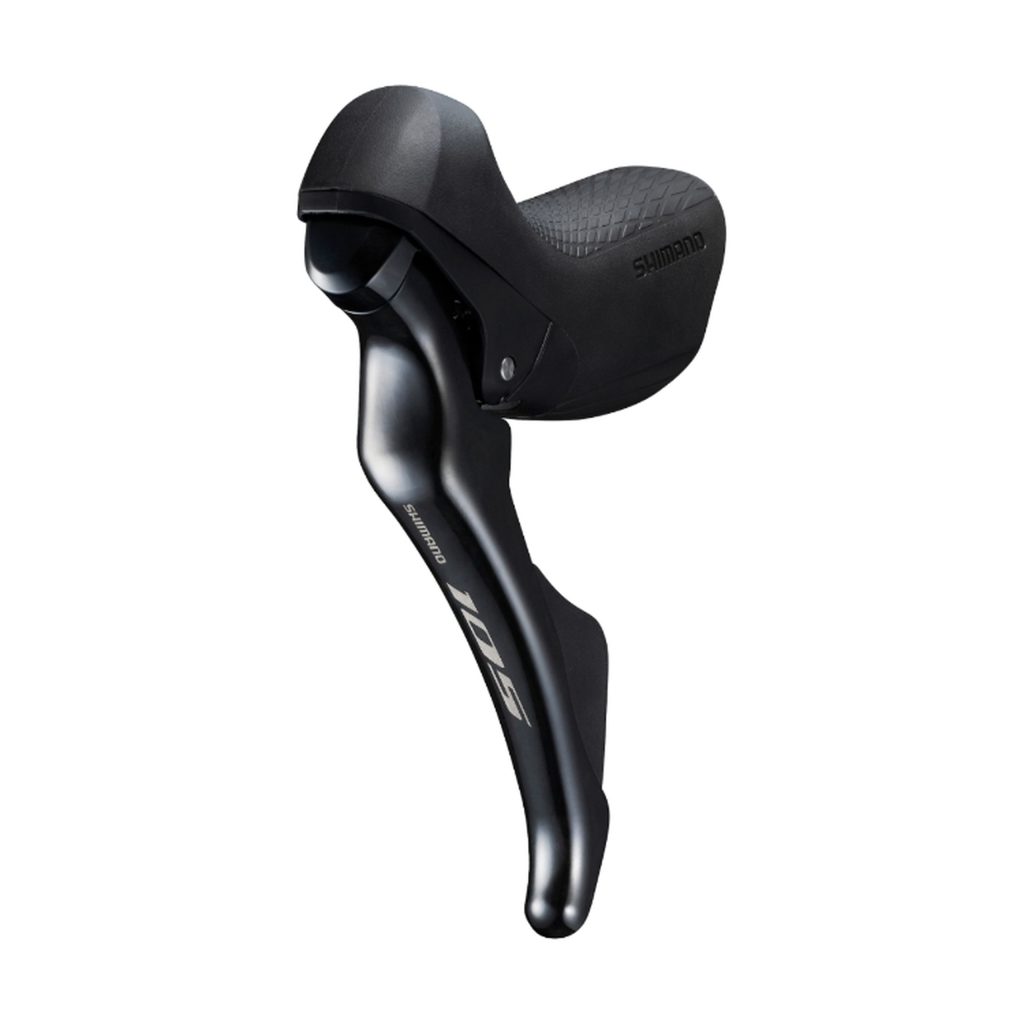
Shimano 105 R7000 dual-control levers closely mimic the ergonomics and mechanism of Ultegra’s shifters, with only minor material differences. The ST-R7000 levers were redesigned from the previous 5800 series. They feature a slightly smaller, squared-off hood shape and a textured rubber grip, which improves comfort and control – especially in wet conditions2. The lever throw (the distance you push to initiate a shift) was shortened compared to 5800, making shifts from the drops easier and faster2. Shimano also increased the reach adjustment range by about 10mm, allowing riders with smaller hands to position the levers closer to the bar for better accessibility2.
Functionally, the shifters use Shimano’s signature STI (Shimano Total Integration) mechanism: the brake lever itself pivots inward to shift to a larger cog/higher gear, and a smaller secondary lever behind it shifts to a smaller cog/lower gear. This setup remains essentially the same as in higher-tier groups, so the shift internals are identical to Ultegra and Dura-Ace in terms of operation3. Where Ultegra/Dura-Ace save weight is in materials: those models use carbon-fiber reinforced brackets and carbon lever blades, whereas 105 uses a fiberglass-reinforced nylon bracket and aluminum lever blades3. As a result, 105 levers are a bit heavier: a pair of R7000 mechanical levers weighs around 475–500g, roughly 40–135g more than Ultegra’s, depending on exact configuration24. (Ultegra R8000 levers have carbon bits that bring their weight down to ~438g, and Dura-Ace R9100 levers ~365g2.) This weight difference is the trade-off for 105’s lower cost – but in terms of shifting feel and performance, riders report that 105 levers are virtually indistinguishable from Ultegra5. The action is snappy and precise, capable of shifting up to 3 cogs in one stroke (to easier gears) and one-at-a-time downshifts, with the same reliability Shimano is known for2. The only foible common to all mechanical Shimano STI levers is that if you accidentally squeeze the brake lever while trying to downshift, the mechanism won’t engage – a minor quirk to be mindful of2.
In summary, the R7000 dual-control levers provide a confident interface: ergonomic improvements, excellent modulation on braking, and crisp shifting. They lack the carbon bling of pricier models, but they are built tough. Many enthusiasts appreciate that 105 doesn’t skimp on function – you get the exact same shifting mechanics as the pro-level groupsets, just housed in a slightly heavier package3.
Front Derailleur (FD-R7000)
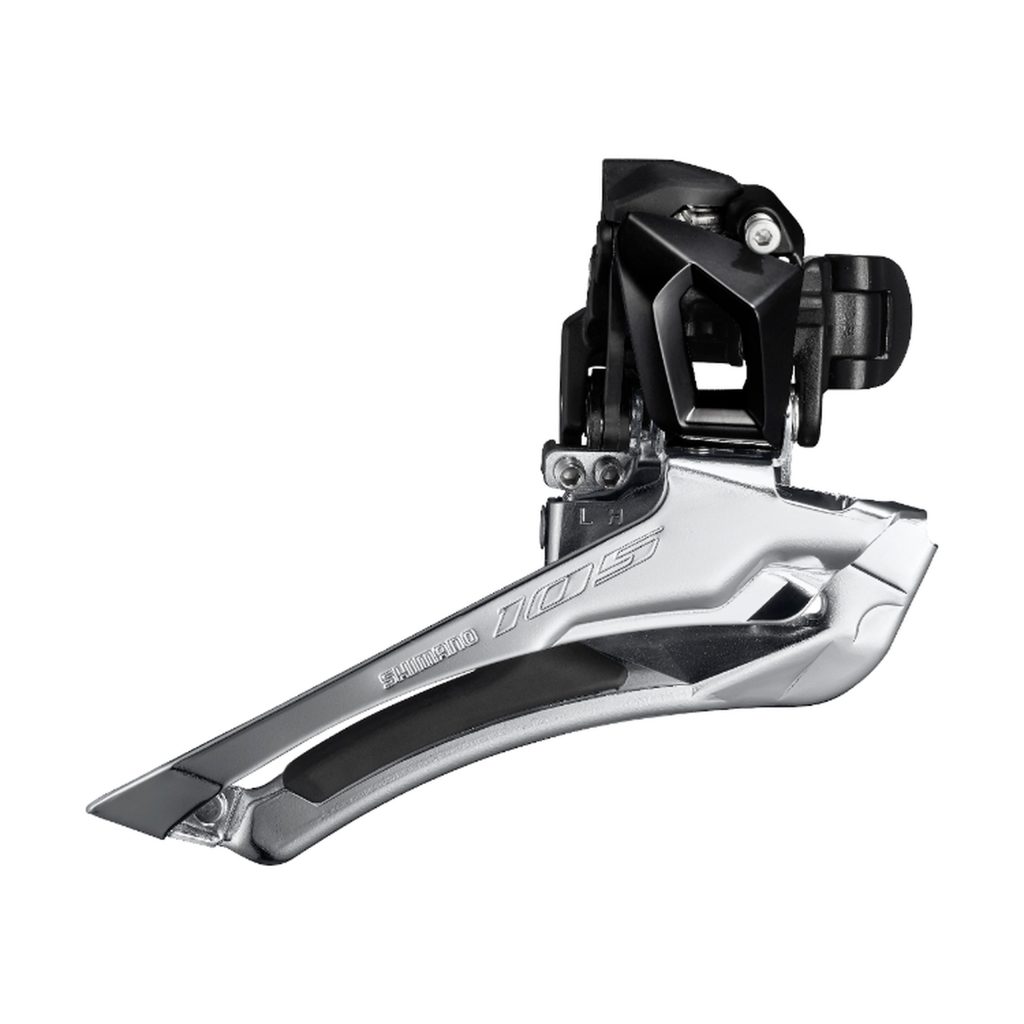
Shimano 105 FD-R7000-B Clamp-On Front Derailleur
Shimano 105 FD-R7000-F Braze-On Front Derailleur
Original price was: $42.99.$15.00Current price is: $15.00.
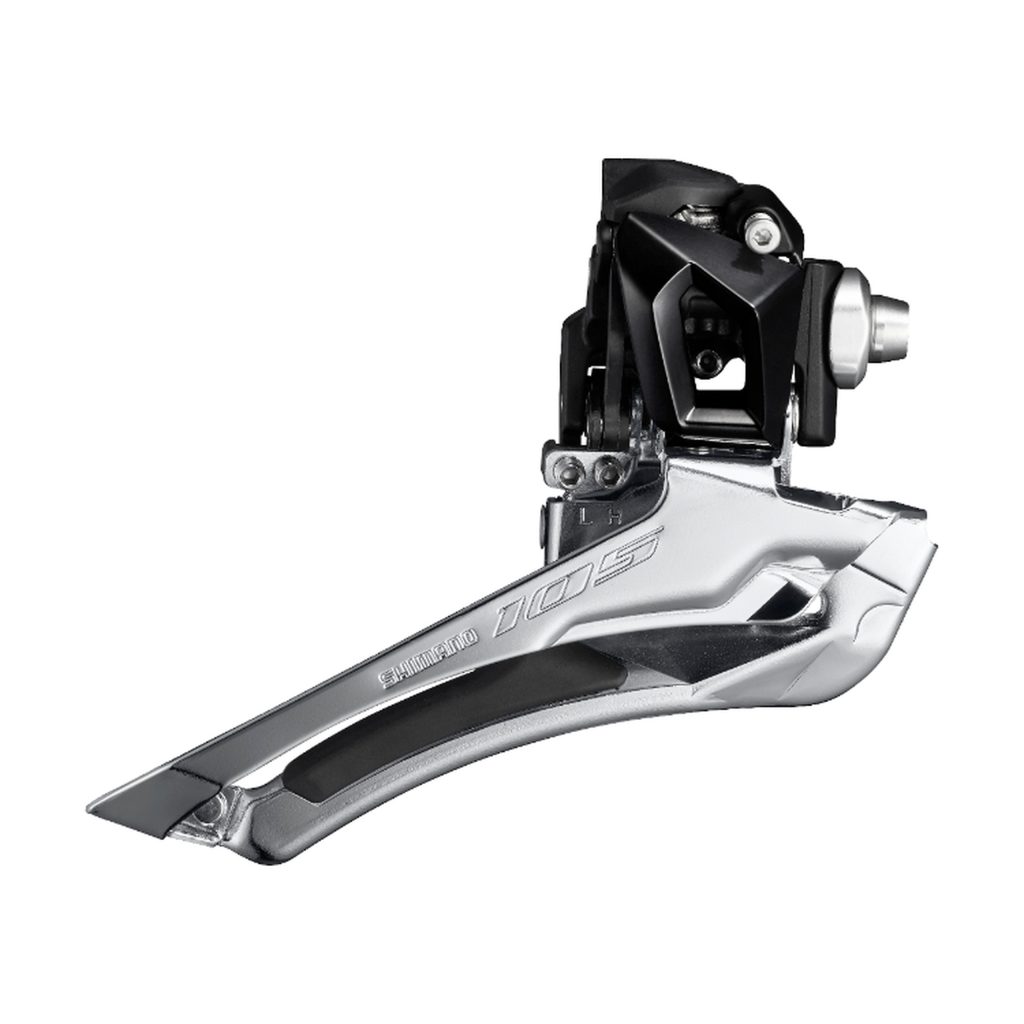
The FD-R7000 front derailleur introduces a new design that was first seen on Dura-Ace 9100 and Ultegra R8000. Shimano calls it a “compact toggle” mechanism4. Unlike the older parallelogram design of 5800, the R7000 front derailleur uses a linkage that changes the pull angle, which allowed engineers to make the derailleur more compact while reducing the force needed to shift. This translates to noticeably lighter and easier front shifts compared to the previous generation2. In fact, testers moving from 5800 to R7000 reported that front shifting is perhaps the single biggest improvement – it’s smooth and predictable even under load, where 5800 sometimes felt a bit stiff2.
The FD-R7000 is an 11-speed front derailleur designed for double chainrings. It can handle large chainrings from 46T up to 53T, per Shimano’s specs4. (By contrast, the Tiagra front derailleur tops out at 52T since Tiagra is 10-speed4, and if you somehow wanted a chainring larger than 53T you’d need to jump to Dura-Ace per Shimano’s recommendations4.) The 105 unit is offered in braze-on style or clamp-band mounts to fit various frames. It has an integrated cable tension adjustment screw on the body4, which is a handy feature. You can fine-tune the cable tension right at the derailleur instead of needing an in-line barrel adjuster on the cable. The new design also increases tire clearance, addressing a gripe from prior generations where the FD cage could come close to rubbing on wider tires or when the bike flexed4.
Materials for the 105 front mech are typical for this level: aluminum outer link and body, with a chromed steel chain guide. This is actually similar to Tiagra’s construction4, both 105 and Tiagra FDs use aluminum and stainless steel, ensuring durability. Weight for the R7000 front derailleur is around 95–110g (braze-on version)24, just a few grams more than Ultegra’s (~92 g). There is no carbon or titanium here, but mechanically it performs on par with Ultegra. The “toggle” linkage design is the key upgrade, and it makes setup slightly different: the FD has a small set screw that rests against the frame or an adapter, and one must be mindful of the new tensioning process (anchoring the cable with the linkage in a specific position as per Shimano’s setup guide). Once dialed in, users have found the R7000 front derailleur to shift cleanly, smoothly, and quietly, even under load4. It also has a built-in trim stop on the big ring to avoid chain rub in cross-gearing, though the need for trimming is minimal if adjusted well because of the angled cage design. Overall, the 105 front derailleur is a shining example of trickle-down tech – you get a front shifting experience that until recently was reserved for top-tier groups.
Rear Derailleur (RD-R7000)
Shimano 105 RD-R7000-GS Medium Cage Rear Derailleur
Price range: $32.00 through $37.49Shimano 105 RD-R7000-SS Short-Cage Rear Derailleur
Original price was: $44.99.$32.00Current price is: $32.00.


The RD-R7000 rear derailleur marks a significant departure from the previous 105 designs. Shimano adopted its Shadow RD technology here4, which was originally developed for mountain bike derailleurs. In the road context, Shadow RD means the derailleur has a lower profile and sits tucked in closer to the cassette and frame, reducing the risk of it snagging or getting bent in a crash. Visually and functionally, the 105 R7000 rear mech closely follows the Ultegra R8000 model launched a year prior4. It looks far more streamlined than the older 105–5800 unit and even at a glance you can tell it’s “new school” 105.
The RD-R7000 is available in two cage lengths: SS (short cage) and GS (medium/long cage). The short cage is intended for tighter-ratio road cassettes (up to ~30T largest sprocket), while the longer GS cage can accommodate wider-range cassettes up to 34T4. Both Tiagra and 105 offer these two cage lengths, but it’s worth noting the slight bump: the old short-cage Tiagra limited you to 28T, whereas 105 short-cage is 30T max4. In practice, 105 GS derailleurs can exceed the stated max – many riders have successfully run 11-36T or even 11-40T cassettes with the R7000 GS, especially if using a longer B-screw or a hanger extender. In fact, testers at road.cc managed to get a 40T sprocket shifting “without any hassle at all” using the long-cage 105 derailleur4. This gives R7000-equipped bikes a lot of range flexibility, which is great for gravel or hilly touring builds that rely on big cassettes.
Construction-wise, the 105 rear derailleur uses aluminum for the main body and links (no carbon fiber on 105, whereas Dura-Ace might use some carbon in the cage). The pulleys run on bushings (Ultegra’s pulleys may have bearings in one of the wheels), but the shifting precision is excellent out of the box. The cable pull ratio for R7000 is the same as other 11-speed road derailleurs, meaning it’s cross-compatible with any Shimano road 11-speed shifter. This also implies you can mix in the gravel-oriented RX/GRX rear derailleurs if you want a clutch mechanism for chain retention. A common hack is using a GRX RD-RX812 with 105 shifters for a clutch and capacity up to 42T, since Shimano designed GRX 11-speed to play nice with road shifters.
In terms of weight, the 105 R7000 rear derailleur comes in around 220–225g for the short cage and a few grams more (227–235g) for the long cage4. This is nearly identical to Ultegra R8000 (which is ~200g SS, 210g GS) – only about a 20–25g difference2. Again, that difference is mostly in materials. Functionally, riders and reviewers find no meaningful performance gap: the R7000 rear mech shifts crisply across the cassette, whether under power or soft-pedaling, and the Shadow design gives it a firm, slop-free feel. It also adds stability; while not a clutch derailleur, the Shadow geometry and a stronger chain wrap reduce chain bounce compared to older designs. Shifting performance is precise and long-lasting, according to Shimano, and users have backed that, noting R7000 provides reliable indexing even after many miles of use4.
One maintenance note: because the R7000 derailleur sits a bit inward, adjusting the B-tension (which sets the upper pulley clearance to the cassette) is important, especially if you max out cassette size. But once set, it’s largely fit-and-forget. Given its robustness and wide-range capability, the 105 rear derailleur is a favorite choice not just for pure road bikes but also for budget gravel or adventure builds.
Crankset (FC-R7000)
The FC-R7000 crankset carries over the 4-arm asymmetric spider design that Shimano first introduced in Dura-Ace 9000. It’s perhaps the most eye-catching part of the groupset, with its sleek, modern aesthetic. Like its Ultegra and Dura-Ace counterparts, the 105 crank uses a hollow forged aluminum construction for the crank arms (Shimano’s Hollowtech II technology) and a 24mm diameter steel spindle integrated with the driveside arm. The use of a steel axle (instead of a larger aluminum axle) might seem old-school since some competitors use 30mm alloy spindles, but Shimano’s design prioritizes bearing durability and frame compatibility. In testing, the R7000 crank proves extremely stiff: road.cc noted you can mash the pedals with virtually no chainring deflection, meaning front shifts under power don’t induce chain rub2. In other words, the power transfer is on par with more expensive cranks, and any theoretical stiffness loss from the smaller spindle is negligible2.
Shimano offers the crank in various chainring configurations to suit different riders. You can get standard racing gearing 53/39T, a mid-compact 52/36T, or a compact 50/34T setup4. All variants use the same 110mm BCD 4-bolt spider – yes, even the 53/39 (Shimano’s engineering allows a 53T ring on a 110 BCD by using that asymmetric arm design)4. This uniform BCD means chainrings are interchangeable among the different setups, which is convenient if you ever want to change ratios. The crank lengths available range from 160mm up to 175mm in 2.5mm increments4. Notably, R7000 was the first 105 series to offer a 160mm crank option, which is great for smaller riders or juniors (previously, 165mm was the shortest in 105).
In terms of materials, the chainrings are aluminum on the outside ring, paired with a fiberglass-reinforced plastic (GFRP) inner support structure in some spots4, and a steel or aluminum smaller ring depending on configuration. The exact construction is similar to Ultegra: the big ring is a stiff aluminum (sometimes with carbon or composite reinforcement) and the small ring is steel for longevity on 105. The crank arms themselves are anodized aluminum with a glossy black finish on R7000 (contrasting the two-tone gray of Ultegra). One difference is that 105’s chainring bolts are steel, whereas Dura-Ace might use alloy or titanium bolts, contributing to a slight weight difference.
Speaking of weight, the 105 R7000 crankset weighs approximately 710g in 50/34 compact form4. A 52/36 or 53/39 will be slightly heavier (a few grams more for the larger rings). Road.cc measured the 50/34 105 crank at 713g2, and a Tiagra 50/34 for comparison was a hefty 910g4, which highlights the benefits of 105’s Hollowtech design over the solid-forged lower-tier cranks. Ultegra’s crank in equivalent size is about 668g2, saving ~45g via lighter materials and some machining. So 105 sits in the middle: not the lightest, but far from heavy. In fact, many riders consider the 105 crank one of the best values because it is significantly lighter than Tiagra’s (almost a 200g savings) while only ~6% heavier than Ultegra’s2. If someone on Tiagra wanted a quick performance upgrade, swapping to an R7000 crank is often recommended because it “works fine in an otherwise Tiagra setup” and immediately drops a significant amount of weight4.
On the bike, the R7000 crank performs admirably. The large chainrings even borrow shift ramp designs from the previous Ultegra, ensuring fast and quiet front shifts. The crankset, with its polished look and race-quality performance, truly embodies the idea of 105 being an “enthusiast level” groupset: you’re not really giving up much on the drivetrain by choosing 105. It’s also durable – thanks to steel inner chainrings and a steel axle, many riders report thousands of miles of use with minimal wear beyond normal chainring tooth aging.
Brakes (BR-R7000)
Shimano 105 BR-R7000 Dual-Pivot Rim Brake Calipers (Pair)
Original price was: $94.99.$84.99Current price is: $84.99.
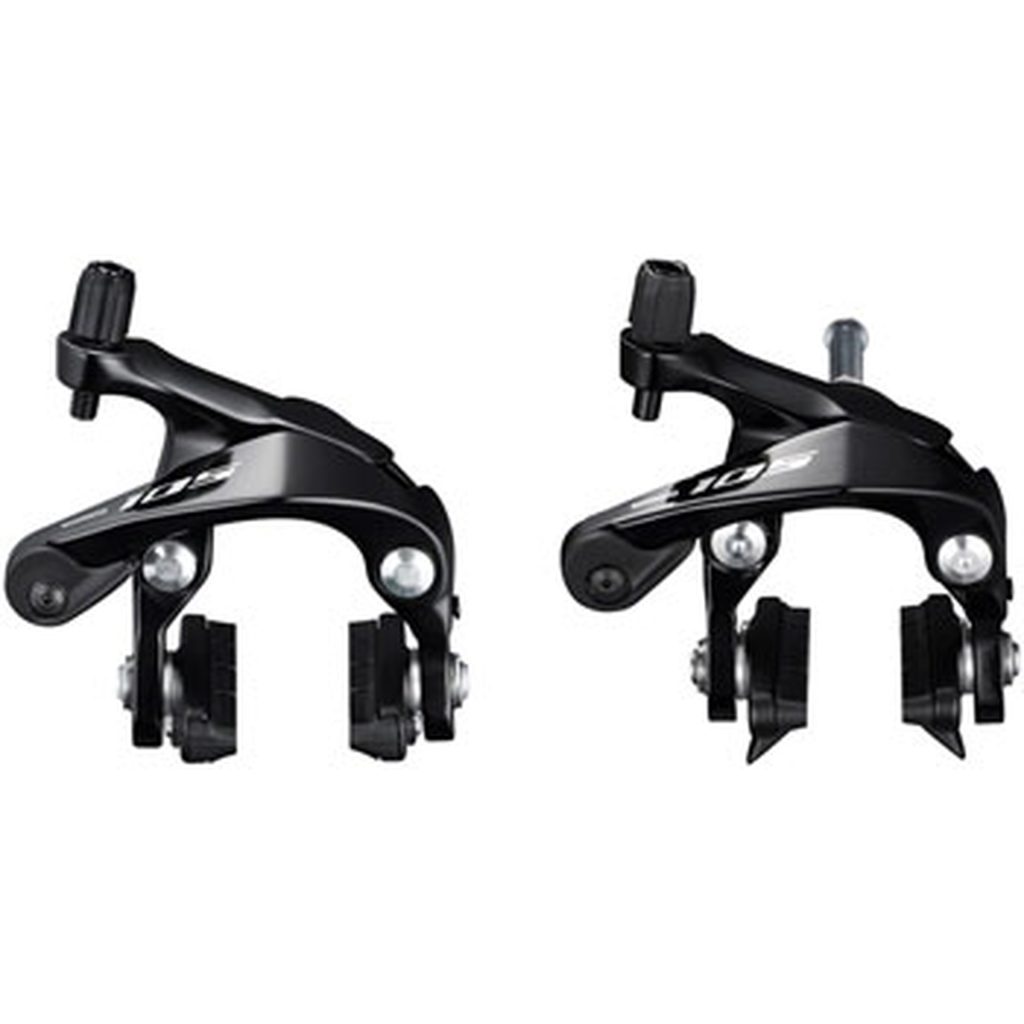
Shimano 105 R7000 includes a set of dual-pivot caliper brakes (BR-R7000 for standard mount, and BR-R7010 for direct-mount versions found on some frames). These calipers are a direct trickle-down from Ultegra’s design. In fact, the major design overhaul for Shimano’s rim brakes occurred in the prior generation (5800), when 105 adopted a symmetrical dual-pivot layout that increased power and modulated more smoothly2. The R7000 calipers mainly refined the aesthetics – they have a sleek black anodized finish and slightly reshaped quick-release lever – and provided a tad more clearance. Officially, they accommodate up to 28mm tires (and often can clear some 30mm tires depending on the frame clearance) which suits the modern trend of wider tires for comfort4. The brake pads use Shimano’s R55C4 compound which offers a good balance of bite and rim wear.
In terms of performance, 105 brakes are widely regarded as a high point of the groupset. They offer strong, confidence-inspiring stopping power with excellent modulation. In a head-to-head test, road.cc found that 105’s brakes are considerably better than Tiagra’s in both outright power and fingertip control4. The feel at the lever is nearly identical to Ultegra – indeed the only difference one might notice is a few grams of weight or a slight finish difference on the hardware. The braking geometry and mechanics are the same. Many riders upgrading from older bikes or lower-tier brakes are impressed by how much of an upgrade 105 dual-pivots provide; you get a very consistent brake response and easy centering with the toe-in adjustable pads. These calipers also use bearings at the pivots (as opposed to bushings on very cheap calipers), contributing to their smooth action.
Weight for the rim brake calipers is about 378–380g per pair (front + rear)6. Ultegra’s brakes weigh a little less (~360 g/pair) by using alloy hardware and perhaps less material on the caliper arms2. For context, SRAM’s Rival brakes are lighter (~300 g) but that comes at a slight cost to ultimate power6. In use, one tester noted Shimano’s brakes have the best pure stopping power, while rival systems might have a subtly “lighter” feel in the lever stroke7. Most riders will find 105’s braking excellent right out of the box. Pad upgrades (to different compounds for wet conditions or carbon rims) are available and the same as for Ultegra/Dura-Ace, since the pad holders are identical across these levels Maintenance on 105 brakes is straightforward. Rim brake calipers have an easy centering screw and quick-release for wheel removal.
Cassette (CS-R7000)
The 105 R7000 series cassettes are 11-speed and available in a variety of ratios to suit road and mixed-terrain riding. Shimano designed the 105 cassette to offer a wide range while keeping weight reasonable and shifting crisp. The standard combinations are 11-28T, 11-30T, 11-32T, and a close-ratio 12-25T for those who favor tighter gearing steps8. Additionally, Shimano introduced an 11-34T cassette (model CS-HG700-11) that carries the 105 branding – this one is interesting because it’s designed to fit on both 11-speed and older 10-speed freehub bodies (it comes with a spacer for 10-speed hubs)9. The 11-34 cassette is often sold as part of the R7000 groupset for riders wanting extra low-end range, effectively bringing 1:1 gearing when paired with a 34T small chainring.
All 105-level cassettes use nickel-plated steel sprockets for durability. However, unlike Tiagra 10-speed cassettes which are one-piece or use all steel carriers, the 105 cassettes incorporate an aluminum spider carrier for the largest sprockets and an aluminum lockring4. For example, on an 11-28 cassette, the top 3–4 cogs might be riveted to an aluminum spider. This saves weight and also adds stiffness to the cluster of big cogs, aiding shift quality under load. It’s a trickle-down feature from Ultegra (which goes further by using some carbon in the spider for even more weight savings). The result: an R7000 11-28T cassette weighs around 280–285g, whereas the equivalent Tiagra 12-28 (10-speed) is about 308g4. If you compare 11-32 cassettes, 105’s is ~320g10. The largest 11-34 cassette (which has extra sprockets and spacers) is heavier at approximately 379g10. Ultegra’s cassettes by contrast drop on the order of 30g from those numbers by using some titanium or lighter spider materials3.
In terms of shifting performance, 105 cassettes are renowned for smoothness. They benefit from Shimano’s Hyperglide tooth profiling which has been honed over decades. Shifts on an R7000 cassette (paired with the R7000 derailleur) feel nearly indistinguishable from Ultegra in most situations. The primary difference is weight and perhaps a slightly less fancy finish (Ultegra cogs have a chromed or carrier plating that looks a bit different, and Dura-Ace uses titanium on the biggest cogs which wear faster but save weight). According to The Pro’s Closet data, an Ultegra cassette is only ~25–35g lighter than 105, and Dura-Ace saves ~150g by using multiple titanium cogs3, but those savings come with exponentially higher cost. So for many, the 105 cassette is the smartest choice – it’s cost-effective, lasts a long time, and shifts crisply.
One thing to note is compatibility: Since it’s 11-speed, a 105 cassette will fit on any Shimano/SRAM 11-speed freehub. And the HG700 (11-34) model’s ability to fit 10-speed freehubs is a nice perk for people upgrading older wheels. Riders doing a lot of climbing or venturing into gravel often opt for the 11-34 cassette with the GS rear derailleur. And as mentioned, some even push beyond 34T using third-party cassettes (e.g., SunRace 11-40T) – the 105 derailleur can handle it with a bit of tweaking4, though Shimano won’t officially list those.
In summary, the 105 R7000 cassettes give you a wide gearing selection, durable steel cogs, and lighter construction than lower-tier cassettes. Keep it clean and it will serve you well for thousands of kilometers. When it does wear out, replacement won’t break the bank compared to the exotic metal cassettes of higher groups.
Chain (CN-HG601)
The 105 R7000 groupset typically comes with Shimano’s HG601 11-speed chain (sometimes listed as CN-HG601-11). This chain is 11-speed specific, meaning it’s narrower than a 10-speed chain to fit the tighter spacing of 11 sprockets4. It features Shimano’s Sil-Tec low-friction coating on the links, which is a PTFE-based treatment to reduce drivetrain noise and wear4. In practice, both Tiagra (10-speed) and 105 (11-speed) chains use Sil-Tec, so they’re very quiet-running chains. The main difference is that the 105 chain is a bit lighter because it’s narrower and has slightly more machining. A new 114-link 105 chain weighs around 257g, whereas the Tiagra 10-speed chain is about 273g4. Shimano’s own specs put the 105 chain on par with the Ultegra chain in weight, and indeed the road.cc review noted virtually no weight difference between 105 and Ultegra chains2– in fact, they are nearly the exact same chain; Ultegra’s CN-HG701 is essentially the same construction with maybe a more hardened pin treatment and comes with a quick-link in newer iterations.
The 105 chain uses Shimano’s Quick-Link (Master Link) or the traditional connecting pin for installation. Shimano for years insisted on a special connecting pin for their chains, but now they also sell master links, making it easier for quick removal or installation. The chain is known for its durability and smooth shifting. Many riders stick with the 105 chain even on Ultegra or Dura-Ace setups because it offers nearly identical performance at a lower cost. In terms of longevity, expect to replace it roughly every 3,000-6,000 km depending on conditions (or measure for 0.5% wear) to maximize cassette and chainring life.
One interesting point: The Pro’s Closet analysis mentions that as you go up the hierarchy, chains get marginally lighter due to additional machining3. For instance, Dura-Ace chains might have perforations or hollow pins to shave a few grams. But those differences are in the realm of 5–10g and don’t markedly change performance. All Shimano 11-speed chains are mutually compatible, so some users even run a Dura-Ace chain on 105 for the slight efficiency gain (the DA chain has a harder surface treatment for lower friction). However, the 105 chain is already very refined: it runs quietly and shifts crisply under load, thanks to precisely shaped link profiles that engage perfectly with Shimano’s cogs and chainrings.
From a maintenance perspective, the 105 chain is like any other high-quality chain: keep it clean and lubed, and it will reward you with smooth shifting. The Sil-Tec coating helps – riders often comment how quietly the drivetrain runs with a 105 chain4. If you ride in nasty conditions, you might opt for a quick-link for easy removal to deep-clean the chain. Replacement chains are reasonably affordable, and you can also use equivalent KMC or SRAM 11-speed chains if desired (though mixing brands sometimes affects shift finesse slightly; Shimano generally likes its own chains for optimal shifting).
Bottom Bracket
For the 105 R7000 crank, the recommended bottom bracket is the BB-RS500 / BB-R60 series, which is Shimano’s English-threaded (BSA) or press-fit bottom bracket for 24mm spindles. In practice, the “105 bottom bracket” is often the same unit that Shimano uses for Ultegra. In fact, the BBR60 (the current model) is shared between 105 and Ultegra groups4. It’s a robust external-cup bearing system for threaded frames, or there are press-fit options (like SM-BB72-41B) for BB86/BB92 press-fit frames.
The 105 bottom bracket cups are aluminum with steel cartridge bearings inside. Shimano improved this “new” BBR60 model over the older 5700-era one by making the cups smaller diameter and reducing friction in the seals. As a result, it’s lighter and spins more freely. A BSA threaded BBR60 weighs about 77g4 (compare that to ~92g for the older Tiagra-level unit) – a small weight difference of ~15g, but it all counts4. The press-fit version is even lighter (~69g) because there are no metal cups, just composite cups pressed into the frame with bearings4.
Durability on these bottom brackets is known to be very good, assuming proper installation and occasional cleaning. Road.cc noted that the 105 bottom bracket “has an excellent reputation for durability”4, and that mirrors community experience: many people find the BBR60 lasts a long time even in wet climates, outliving some of the more boutique ceramic units unless those are meticulously serviced. And since 105’s BB is inexpensive to replace and identical to Ultegra’s, it’s often not worth spending a lot more for minimal gains (Dura-Ace’s BB is basically the same size and weight, just with even lighter seals or different grease).
In summary, the 105 bottom bracket is simple and effective. It doesn’t draw much attention because it just quietly does its job. The bearings are smooth, the cups are easy to install with the standard Shimano tool, and it handles the loads of stiff pedaling without issue. If you’re running a 105 crank, you’re essentially also running an Ultegra bottom bracket – there’s no disadvantage there. Just remember to keep the BB area clean; if you ride in the rain a lot, a yearly check/relubrication of the BB might keep it spinning indefinitely.
Shimano Comparisons
Shimano organizes its road groupset hierarchy as Sora/Tiagra (entry level), 105 (enthusiast level), Ultegra (race level), and Dura-Ace (professional level)3. The 105 R7000 group occupies that sweet spot where performance meets affordability. It’s helpful to compare R7000 against its Shimano stablemates – specifically Tiagra 4700 below it and Ultegra R8000 above it (plus a nod to Dura-Ace) – to understand what differences exist in features, weight, and compatibility.
105 R7000 vs Tiagra 4700
Speed and Drivetrain: The most obvious difference is that Tiagra 4700 is a 10-speed system, whereas 105 R7000 is 11-speed4. That means 105 has one extra sprocket, allowing closer gear steps or a wider range for the same cassette size. Riders choosing between them often consider whether they want that extra gear. In practice, 11-speed’s popularity in performance and enthusiast bikes means more compatibility with wheelsets and future upgrades. Tiagra, being 10-speed, is slightly isolated in that it uses its own shifters and derailleurs (though interestingly Tiagra 4700 adopted the same cable pull ratio as 11-speed, meaning a Tiagra 4700 shifter can actually operate an 11-speed derailleur and vice versa in friction terms4, but you can’t mix cassettes or chains because of the different speeds).
Shifting and Derailleur Design: R7000 brought in advanced designs that Tiagra lacks. For the rear derailleur, 105’s Shadow RD design tucks the mech in and increases capacity (30T short cage, 34T long cage)4. Tiagra’s rear derailleur is an older style that sits further out and officially tops out at 28T (short) or 34T (long)4. So in practice, both can hit 34T with a long cage, but 105 does so in a more compact form and with slightly crisper shifting (partly due to that Shadow geometry). The front derailleur on 105, as discussed, uses the toggle link, whereas Tiagra’s is a traditional design. Both Tiagra and 105 FDs are aluminum/steel and shift well, but 105’s has the edge in engineering – the toggle linkage gives lighter action, more tire clearance, and an integrated cable adjuster4, none of which Tiagra’s FD has. Tiagra is also the highest group still offering a triple front derailleur (for 3 chainrings)4. If someone needs a 3x setup (e.g. 50/39/30 for touring), Tiagra can do that, whereas 105 is double-only (2x)4. So Tiagra maintains that nod to touring triple users.
Brakes: Both groups offer dual-pivot rim brakes and now both offer hydraulic disc brakes as well (Shimano later introduced Tiagra-level hydraulic disc options). In terms of rim brake performance, testers highlight that 105’s brakes are a noticeable step up. They use an aluminum brake shoe carrier and slightly different pivot geometry, resulting in more power and modulation than Tiagra’s calipers4. Weight-wise, 105 calipers are lighter (about 379g vs Tiagra’s ~418g per pair, if we compile from various data). Also, Tiagra’s calipers might not clear a 28+mm tire as easily as R7000’s – 105’s are designed with modern clearance in mind, whereas Tiagra 4700 was launched when 25mm was standard.
Crankset and Bottom Bracket: Tiagra’s FC-4700 crank is a solid-forged design (not hollow), and it’s heavy at around 910g for a 50/34T4. It does use the same 110mm BCD 4-bolt pattern, which was a nice upgrade over previous Tiagra. 105’s crank, at ~716g4, is dramatically lighter and a bit stiffer. Both use the same BB interface (Hollowtech II, 24mm axle). The bottom brackets are actually cross-compatible – in fact, as noted, the 105 BB is often used as an upgrade for Tiagra bikes due to better seals and slightly lower weight4. Tiagra cranks also come in only compact (50/34) or semi-compact (52/36) and triple, whereas 105 adds the 53/39 option for those seeking true race gearing4. This reflects Tiagra’s positioning towards fitness/recreational riders who rarely demand a 53T big ring.
Weight Differences: Across the board, a 105 R7000 groupset is lighter than Tiagra 4700 – roughly by 400–500 grams in total, which is significant4. For example, the shifters: 105’s dual-control levers are ~476 g/pair vs Tiagra’s ~493g4(not huge, but some difference due to 105’s lighter internals). The derailleurs: 105 rear (long cage) ~227g vs Tiagra long cage ~277g4, and 105 front ~95–109g vs Tiagra ~106g (so front is similar weight, but rear 105 is much lighter)4. The cassette: an 11-28 105 is 284g vs Tiagra’s 12-28 at 308g4. Chain: 105’s 11-speed chain 257g vs Tiagra 10-speed 273g4. Bottom bracket: 105 threaded 77g vs Tiagra 92g4. These differences, while individually small, add up to a tangible weight saving of nearly a pound. Of course, weight isn’t everything, but it contributes in a small way as to why higher-tier groups feel a bit more “effortless” on climbs and sprints.
Feel and Performance: Perhaps the most important comparison is feel. By most accounts, Tiagra 4700 is an excellent groupset in its own right – it brought much of 105’s prior generation tech down to a lower price. It shifts reliably and many riders are happy with it on entry-level road bikes. However, stepping up to 105 R7000, you get that extra gear and a refinement in shifting. Reviewers say 105’s shifts (especially front shifts) are lighter and faster, and the overall operation is “silkier.” The materials in 105 also tend to be a bit nicer: for instance, the 105 cassette has that aluminum spider so it’s not just lighter, it may run a tad quieter and put less stress on the freehub. And the 105 crank’s hollow arms give a more solid pedaling response compared to Tiagra’s heavier arms.
In terms of upgrade path, one thing to consider: Tiagra 4700 and 105 R7000 parts aren’t mix-and-match except for a few exceptions, because of the 10 vs 11 speed difference. You can use a 105 rear derailleur with Tiagra shifters as a temporary upgrade (since the pull ratio is compatible)4, but to truly go 11-speed you have to change shifters, cassette, chain – basically most of the drivetrain4. Conversely, if you start with 105, you can later swap in Ultegra or Dura-Ace components one by one as they wear out, since they’re all 11-speed and cross-compatible4. That “gradual upgrade” path is a nice advantage of starting at 105 or above.
Summary: 105 R7000 clearly outperforms Tiagra 4700 in key areas: it’s lighter, gives an extra gear, has stronger brakes, and incorporates more advanced tech (Shadow RD, toggle FD). Tiagra remains a high-value choice for tighter budgets and is impressively close in performance, but if funds allow, 105 is worth it for the better brakes, small weight savings, and the jump to 11-speed4. As one reviewer concluded, “Tiagra offers excellent value, but 105 is certainly the better groupset…we’d recommend going for it if your budget allows”4. Enthusiasts often regard 105 as the minimum for a “serious” road bike because it so closely mimics the top-tier experience.
105 R7000 vs Ultegra R8000
When comparing 105 to Ultegra, we’re looking at two generations from the same era (R7000 and R8000 launched within a year of each other3. They are both 11-speed and nearly identical in functionality. In Shimano’s trickle-down strategy, Ultegra is essentially a lighter, fancier-finished version of 105 – or put another way, 105 now emulates Ultegra so well that performance differences are negligible2. Let’s break it down:
Shifting and Ergonomics: The shifter shape and mechanisms are the same between 105 R7000 and Ultegra R8000. As noted earlier, the only real differences are material: Ultegra levers have some carbon fiber in the lever blades and use a carbon-reinforced plastic body, which makes them lighter (Ultegra levers ~438g vs 105’s ~500g per pair)2. The feel of the shift – the effort and feedback – is virtually identical. Shimano confirmed that internally the ratchets and springs are the same, so any perceived difference is mostly placebo or due to handlebar setup. One key distinction at the time: Ultegra offers electronic shifting (Ultegra Di2 R8050) while 105 was mechanical-only in R7000. So if someone wanted Di2 electronic, 105 was not an option in 2018 (though in 2022 Shimano finally released a 105 Di2 12-speed). But mechanical vs mechanical, R7000 and R8000 shift the same in most riders’ eyes5.
Derailleurs: Both front and rear derailleurs in Ultegra R8000 are basically the same design as 105, but marginally lighter. The Ultegra rear derailleur swaps a few materials – for instance, the cage on Ultegra might be anodized aluminum or part carbon and the limit screws aluminum instead of steel – to save ~25g (Ultegra RD short cage ~200g vs 105’s ~225 g)2. Ultegra’s rear mech also comes in short and long cage, handling the same cassette sizes (30T short, 34T long officially, and similarly can go beyond with hacks). For the front derailleur, Ultegra R8000 and 105 R7000 are so close that even weights are within a couple grams (Ultegra ~92g, 105 ~95g2). Both have the integrated cable adjuster and toggle design; the Ultegra one uses a few more alloy bits to shave those grams.
Crankset and Bottom Bracket: The Ultegra R8000 crankset is a beauty – it uses the same general design but with some different aluminum alloys and possibly more machining inside the arms. It weighs about 50g less than the 105 crank (for example, 50/34 Ultegra ~668g vs 713g for 105)2. It also has a two-tone glossy dark gray finish versus 105’s solid black. Functionally and stiffness-wise, they are extremely close. You might get a tiny stiffness edge with Ultegra, but even strong riders would be hard-pressed to tell. The chainrings on Ultegra have some finer machining and ramps, but again, shift performance between Ultegra and 105 chainrings is nearly indistinguishable in practice. They both use Hollowtech II BBs; interestingly, 105 actually uses the exact same BB as Ultegra, so no difference there4. So in terms of power transfer and smooth rotation, 105 holds its own very well.
Brakes: Ultegra R8000 rim brakes have a slightly different finish and use a few lighter parts (titanium or alloy bolts). They also have an optional carbon brake pad cartridge in some cases. The result is a small weight drop (Ultegra ~360g/pair vs 105 ~379g)2. Performance-wise, they are the same design, so braking power and modulation feel identical between Ultegra and 105 rim brakes7.
Cassette: The Ultegra cassette is one area of slight improvement: Ultegra cassettes use an anodized aluminum lockring instead of steel, and the spider carrier is carbon fiber reinforced for the largest cogs. Still all steel cogs (except Dura-Ace which has Ti ones), but this change saves ~30g and maybe gives a tiny shift crispness (though that’s debatable). So for instance an Ultegra 11-28 is ~251g vs 105’s 284g2. Shifting quality between a new 105 and Ultegra cassette is essentially the same; only in extreme conditions might the Ultegra’s materials make it a tad quieter or more durable.
Chains: Ultegra’s chain (HG701) and 105’s (HG601) are identical except Ultegra’s has a silvery grey plating and supposedly one more surface treatment. Weight is the same (~257 g)2. In fact, in the road.cc comparison chart, the chain was exactly equal weight and they said you’d be hard-pressed to justify upgrading a 105 chain for a 3g savings2. Dura-Ace chain saves maybe 10g with hollow pins.
Performance and “Feel”: If you ask seasoned riders to compare 105 R7000 and Ultegra R8000 in a blind test, most would struggle to tell them apart on function alone. Multiple reviewers have stated that there is no meaningful performance advantage to Ultegra; it’s primarily a weight and finish difference25. Shifts are equally reliable. Where Ultegra might have an edge is in very fine tactile feel – e.g., the shifter click might feel slightly “crisper” due to different materials damping sound, or the brake lever return might feel a hair snappier with the lighter lever. But these are small nuances. Sometimes, enthusiasts describe Ultegra as having a more “refined” or smoother feel, but others say it’s placebo and that a well-tuned 105 is just as silky. Even Shimano’s official line is that the groups are functionally equivalent, Ultegra is just the lighter package for racers who count grams. The Pro’s Closet noted that aside from weight, Ultegra uses more polished aesthetics – for example, 105 has a matte black finish, whereas Ultegra has a two-tone mirror finish that some find more premium3. But they reiterated that shifters, derailleurs, brakes – all perform essentially the same between 105 and Ultegra3
One notable difference: Ultegra offers more high-end options, like a wider range of cassette sizes (it officially has an 11-25 and 14-28 and such, though 105 covers most common ones too), and of course Ultegra Di2 electronic shifting.
Longevity: There is a perception by some that Ultegra and Dura-Ace might last longer due to higher-end bearings or coatings. One forum comment from a user noted they had a 6-year-old Dura-Ace rear mech functioning like new, whereas they had “chucked 105 mechs after 18 months”2. This is anecdotal and not a universal rule – many people run 105 for years without issues. It could be down to heavier use or harsher conditions on the 105 parts in that case. Generally, Ultegra and 105 share the same durable DNA, but Dura-Ace does have some longevity advantages (like coated pivots, etc.). Between 105 and Ultegra, durability is comparable, and they even share many small parts.
Weight Summary: A full 105 R7000 mechanical rim brake groupset weighed about 2,718g, whereas Ultegra R8000 was about 2,514g – so roughly a 200g difference (and Dura-Ace 9100 was ~2,201g, about 500g lighter than 105)2. That 200g is significant for elite racers or weight weenies but for an average rider it’s not game-changing.
Value: Perhaps the biggest reason people gravitate to 105 is value. Ultegra components can cost nearly twice as much, for what is effectively a modest weight drop and a bit of prestige. As road.cc put it, “Is it worth spending the extra to get Ultegra over 105 these days? Not in my opinion, for the riding that I do… In terms of functionality there is no compromise [with 105]”2. That sentiment is echoed by many cyclists: unless you need the slightly lower weight or you’re chasing that high-end feel, 105 gives you 95% of the experience for 50% of the price.
In conclusion on 105 vs Ultegra: They’re closer than ever. Ultegra is the choice for those who want a lighter or more race-focused build (or electronic shifting), while 105 R7000 is almost indistinguishable in day-to-day use. Upgrading from 105 to Ultegra purely for performance reasons is hard to justify, since “there’s no aspect of [105’s] performance that would be meaningfully improved by going one rung up”2. It truly comes down to weight, finish, and personal preference. The great thing is that 105 parts can be mixed with Ultegra and Dura-Ace freely, so one can always upgrade certain pieces if desired (for example, using an Ultegra cassette or chain on 105 to save a few grams). But out of the box, 105 R7000 is so good that it essentially rendered Ultegra a luxury rather than a necessity for performance cyclists.
(And for completeness: Dura-Ace, one tier above Ultegra, adds more exotic materials like lots of titanium, carbon, and ceramics to drop another ~300–350g and offer the absolute pinnacle of Shimano engineering. However, in pure functionality, even Dura-Ace doesn’t shift better than Ultegra/105 – it’s just lighter and more efficient. This underscores how far 105 has come: it’s better in performance than the top-of-the-line Dura-Ace was a couple generations ago2.)
Cross-Brand Comparisons
No component group exists in a vacuum, and Shimano 105’s closest competitors come from SRAM and Campagnolo. Around the time of R7000, the equivalent groupsets were SRAM Rival 22 (mechanical 11-speed) and Campagnolo Centaur (mechanical 11-speed). Each brand has its own design philosophy, so while the basic function is the same (to get you through the gears and slow you down), there are differences in feel, weight, and features. Let’s compare 105 R7000 to SRAM Rival 22 and Campagnolo Centaur 11.
Shimano 105 R7000 vs SRAM Rival 22
Overview: Shimano 105 and SRAM Rival sit at the third-tier in their lineups (below Ultegra/Force and Dura-Ace/Red respectively)6. Both are 11-speed mechanical groups aimed at the same rider demographic – those who want race-worthy performance without the top-tier price. Bikes around the $1,000–$2,000 range often come specced with either 105 or Rival. Rival 22 (sometimes just called Rival) was SRAM’s 11-speed group introduced in 2013–2014, around the same time as Shimano 5800. By the R7000 era, Rival was a mature product, and SRAM had also launched a variant called Rival 1 (for single-chainring setups). For our comparison, we’ll focus on Rival 22 which is the direct analog to 105 (2×11 drivetrain).
Shifting Mechanism: The biggest practical difference is how you shift gears. Shimano uses the dual-lever STI system (brake lever + small lever) while SRAM uses its patented DoubleTap system, meaning a single shift paddle behind the brake lever does both upshifts and downshifts7. With DoubleTap, a short click (“tap”) moves to a smaller cog (harder gear), and a longer push (“double tap”) shifts to a larger cog (easier gear)7. The brake lever itself on SRAM does not move side-to-side – it’s fixed for braking only – which contrasts with Shimano where the brake lever pivots laterally for one of the shift directions. This leads to a different feel: Rival’s shifting is often described as having a more pronounced click/clunk feel, with a single lever motion. Shimano’s is a two-lever system with a perhaps more continuous feel. Is one better? It really comes down to rider preference7. If you’re used to one, the other might feel foreign at first. Some riders love SRAM’s single-lever simplicity, others prefer the tactile separation of brake and shift levers that Shimano provides. Neither is objectively superior – they both reliably execute shifts when properly adjusted7.
Ergonomics: Rival and 105 have different hood shapes. Rival’s hoods are somewhat taller and bulkier, partly due to the DoubleTap mechanism’s packaging. Some riders with larger hands like the bigger SRAM hoods as they fill the palm, and they can offer good leverage in certain positions. Others with smaller hands or a preference for a slim grip prefer the Shimano 105 hoods, which are more compact7. A frequently heard opinion is that SRAM’s hoods give a great grip especially when riding on the hoods during hard efforts7. Meanwhile, Shimano’s hoods are praised for all-day comfort and a rounded shape that suits a variety of hand sizes. Both Rival and 105 levers offer reach adjust: Shimano 105 can adjust reach by ~10mm for the whole lever, while Rival 22 has independent reach adjustment for the brake lever and shift paddle7. This fine-tuning on SRAM might benefit those who want to tweak each lever position separately.
Weight: Weight weenie alert – SRAM Rival 22 is actually lighter than 105 R7000 in most aspects, despite being in the same class. For instance, Rival 22 shifters weighed around 332 g/pr vs 105’s ~486 g/pr6. Rival’s rear derailleur (short cage) is about 180g vs 105’s 225g6. Rival’s front derailleur was ~89g, essentially the same as 105’s ~89–95g6. Rival’s crankset with BB30 spindle (if used) can be lighter too, but SRAM usually offered Rival cranks in GXP (24mm steel axle) format as well, which were comparable to 105’s weight. Overall, a rim-brake Rival 22 group came in around 2.33kg, compared to 105’s ~2.48kg in one magazine’s calculation6. So Rival “wins the weight war” by roughly 100–150g7. This weight advantage largely comes from SRAM’s aggressive use of materials: Rival’s levers might have more plastic composite (and less metal) inside, and SRAM’s skeletal brake caliper design is lighter. Also, Rival’s cassettes can have some alloy spider pieces. However, weight isn’t everything; Shimano tends to put an emphasis on reliability and smoothness, sometimes at the cost of a few grams.
Drivetrain and Compatibility: Both 105 and Rival are 11-speed, but their cassettes and chains are cross-compatible: you can use a SRAM cassette/chain on Shimano or vice versa because the spacing is effectively the same (and freehub standard is the same Shimano Hyperglide interface). Many cyclists mix Shimano and SRAM cassettes/chains without issue, though Shimano chains are often quieter7(there’s an anecdote that “SRAM chain is always louder”7). The chainrings differ: Rival’s front derailleur uses Yaw technology (described below), meaning it doesn’t need a trim feature. Rival chainrings are matched to that system with a special ramp profile. Shimano’s chainrings are matched to their own front derailleur movement. In practice, you wouldn’t mix those anyway.
Front Derailleur – Yaw vs Traditional: SRAM Rival’s front derailleur (for double) uses SRAM’s Yaw technology, which means the FD cage actually rotates slightly as it moves inward/outward, effectively eliminating the need for manual trim adjustment6. The Rival FD can also come with a built-in chain catcher to prevent chain drop6. The Yaw concept is that the FD is always optimally aligned with the chain line. In usage, it means you just have two click positions (one for each ring) and no trim, and you shouldn’t experience chain rub except possibly at extreme gear combos. Shimano’s 105 FD by contrast has a micro-trim position on the big ring (so effectively three positions: low, high, and a trim in high). Trim is rarely needed if properly set, but it’s there. Some riders find SRAM’s front shifting “snappier” due to no trim and a more instantaneous cage movement; others find it “more finicky” to set up and requiring fine timing on shifts11. Reviews often note that SRAM’s Yaw front shift can feel more abrupt but once tuned, it’s very effective. Shimano’s front shifts are a bit more fluid and tolerant. Neither Rival nor 105 are known for poor front shifting – both are quite good. It’s more a matter of feel: SRAM’s shift is a decisive single click, Shimano’s is a sweeping motion with a positive but softer feedback. If you prioritize never trimming and perhaps a more mechanical feel, Rival appeals; if you like the idea of a lighter finger effort and don’t mind the concept of trim (which, again, 105’s toggle FD minimized anyway), then 105 is great.
Brakes: For rim brakes, Rival 22 calipers use a dual-pivot design as well, with a minimalist “skeletonized” caliper style SRAM is known for. These are lighter (as noted) but some say they sacrifice a tiny bit of ultimate rigidity. In terms of performance, Shimano’s rim brakes are often rated a touch higher in absolute power, while SRAM’s can have a different modulation feel – perhaps a bit more linear and “delicate” control7. A reviewer on BikeRoar mentioned if forced to choose, Shimano might have the edge in pure stopping power, but SRAM (and Campy) calipers can offer very fine modulation for feathering speed7. The differences are subtle. Most likely, with identical pads and wheels, a rider would find both Rival and 105 brakes more than sufficient.
User Feedback and Feel: Many users online debate 105 vs Rival and often it comes down to preference and familiarity. Some key points that come up:
- Shifting feel: Shimano is often described as “smoother” or more “buttery,” whereas SRAM is described as “crisp” or “tactile.” For example, one Reddit user summarized: “Shifting on Campy feels way better but is more finicky… braking on Campy feels great, as did 105. 105 is bombproof… you’re not missing anything by going with 105.” (That user was comparing Campy and 105, but similarly Rival’s shifting might be seen as either better or worse depending on taste)11. Another commented that 105 and Ultegra feel exactly the same in use5– implying 105 is already at a high performance point.
- Noise: SRAM drivetrains historically can be a bit noisier (chain buzz) if not perfectly tuned, while Shimano tends to run quieter. This is partly due to differences in chain design and maybe the Yaw FD needing precise setup.
- Maintenance: Mechanics often note that Shimano is more ubiquitous – any shop will have 105 spares, and every mechanic knows how to service STI levers. Rival is also common, but there’s a tad more prevalence of Shimano, simply because Shimano has a larger market share3. One forum user pointed out “everyone knows how to work on [105], replacement parts are readily had and for less money”11, highlighting Shimano’s advantage in widespread support.
- Durability: Both groups are durable, but “bombproof” is a term often applied to 10511. Rival is durable too, but SRAM’s earlier generations sometimes had people complaining about things like the front shifting requiring more frequent tune-ups or the DoubleTap lever developing a little play over time. Modern Rival is improved, but Shimano’s reputation for reliability gives 105 an edge in confidence.
Integration and Options: Rival 22 did offer some options 105 didn’t at the time, like a single-chainring (Rival 1) setup with a clutch derailleur for cyclocross/gravel. Shimano responded later with GRX series. For a road 2×11, though, Rival and 105 are directly comparable. Rival’s standard gearing options (via cassettes) included up to 32T in a road cassette; with WiFli long cage RD, Rival could officially hit 32T (unofficially a 11-36 cassette from SRAM’s MTB line could be used with a hanger extension). 105’s long cage does 34T officially, and we know it can push 40T with a trick. So Shimano might have a slight official edge in max range (34 vs 32 without resorting to non-series cassettes). However, SRAM also had the advantage of the XD driver and 10T small cogs on some setups (not Rival 22, but the 1x gravel setups). But that’s beyond Rival 22’s scope.
Overall: When directly compared, Rival 22 and 105 R7000 perform at a very similar level. Rival is lighter by a bit, and some riders absolutely love its DoubleTap shifting for its simplicity and distinct feel. 105 is a touch heavier, but many love its refined, proven design and quieter operation. If one is used to Shimano, jumping to SRAM can feel strange and vice versa. For a buyer choosing a new bike, it might come down to test riding each. There’s a reason both groupsets have strong fans – neither will really hold you back. In terms of market, Shimano 105 historically dominated OE spec on bikes, meaning you’ll see 105 on a lot more bikes than Rival. Rival-equipped bikes exist, but often at a given price point you might find a slightly higher model from Shimano versus a slightly lower from SRAM.
So from a neutral perspective, 105 offers slightly smoother shifting and more widespread serviceability, Rival offers a snappier feel and a minor weight advantage. Both are reliable. One commenter on Reddit put it succinctly: “105 and Ultegra are nearly identical designs and feel exactly the same, just with a bit of weight difference (~200 g)…”12and similarly, Rival and Force (SRAM’s Ultegra equivalent) are mostly weight and material differences. So 105 vs Rival is akin to Ultegra vs Force – a matter of taste. If you’re someone who geeks out on mechanical precision and likes a definitive thunk with each shift, you might lean Rival. If you prefer an almost invisible functioning drivetrain that you never think about (because it just works), 105’s for you.
Shimano 105 R7000 vs Campagnolo Centaur 11
Campagnolo’s equivalent to 105 is Centaur, which was reintroduced in 2017 as an 11-speed all-mechanical, all-aluminum groupset aimed at the mid-range market. Campagnolo historically had Veloce (10-speed) in that segment, but Centaur 11 was positioned to directly challenge 10513. It sits below Campag’s Potenza (which is more like Ultegra) and Chorus/Record (which are high-end). The question often asked: is Centaur a “105 killer” or at least on par? Let’s see:
Shifting and Ergonomics: Campagnolo has a very different ergos and shifting method via their Ergopower levers. Centaur Ergopower levers feature one lever hidden behind the brake lever for upshifts (to larger sprockets) and a thumb button on the hood for downshifts (to smaller sprockets). So unlike Shimano’s and SRAM’s entirely index-finger operated systems, Campagnolo requires your thumb for certain shifts when your hands are on the hoods. Many riders love Campy’s system because it allows shifting multiple gears: Centaur’s Ultrashift internals (similar to Potenza’s) let you shift up to 3 cogs larger in one sweep and 1 cog smaller at a time7(Centaur was slightly toned down from higher models which can do even more). The thumb lever also means that when you’re in the drops, reaching it is a bit tricky – this is a common critique of Campagnolo design. On the flip side, people with smaller hands often enjoy that Campy’s brake lever doesn’t move side-to-side at all (that’s handled by a separate lever and the thumb button), and Campagnolo’s hood shape is very ergonomic in its own way. The Centaur levers are similar in shape to higher-end Campy – relatively slim and with a nice contour that some find more comfortable than either Shimano or SRAM. As one Reddit user stated, “the Campag hoods are way nicer imo, I like their smaller size and shape”11compared to 105, although that’s subjective.
Mechanics: Centaur’s internals and materials: it uses aluminum brake levers and carbon-reinforced polymer for the shift levers and bodies7. In effect, Centaur levers are not all alloy; they do have some carbon/plastic composite inside, much like 105 levers have plastic in them. Campagnolo historically uses a ratcheting mechanism with springs that gives a distinct tactile feedback – some describe it as a “click-click-click” with more resistance per shift than Shimano’s light action. So the feel of shifting Campy is different: more effort required but also more mechanical feedback. Enthusiasts often say Campagnolo’s shifting feels “positive” and “precise” in a satisfying way, while Shimano’s feels “easier” or “lighter”. Neither is bad, it’s personal preference. One user comment said, “shifting on Campy feels way better but is more finicky – you need to time it better, but the result is better as well”11. By “timing,” they likely refer to syncing your pedal stroke with the shift – Campagnolo can be very smooth if you ease up pressure a hair during the shift, rewarding skill, whereas Shimano might brute-force shifts even if you’re stomping (but might do so with a bit more chain chatter). Campy lovers often relish that feel and the slight nuance in operation.
Front Shifting: Campagnolo’s front derailleur on Centaur is a traditional double (and they do still offer a triple in some lower groups but Centaur is double-only). It requires trimming in some gear combos, just like Shimano. Historically, Campy front derailleurs had multiple trim positions and could move very quickly. Centaur’s FD performance is reportedly on par with Potenza’s – very good, with perhaps a slightly stiffer lever feel than Shimano. It doesn’t have the toggle link; it’s a classic style, but Campy refined their front derailleurs a lot in recent years for 11-speed. So in use, it’s comparable: a strong swift action shifts rings with authority.
Brakes: Centaur rim brakes are dual-pivot as well, forged alloy arms, with a design reminiscent of earlier Chorus brakes. They provide excellent stopping, comparable to 105/Rival. Some say Campagnolo brakes (with Campy pad compound) have a different modulation – maybe a little more progressive. But again, these differences have narrowed as all are dual-pivot now. Centaur did not initially come in a disc brake version – Campagnolo did not offer disc brakes at Centaur level (their official disc brakes start at Chorus/Potenza level)7. This is a significant shortcoming in the modern market: bikes specced with Centaur would be limited to rim brake models, as no “Centaur disc” existed7. (However, some disc-brake bikes use a mix: say Centaur drivetrain but third-party or Potenza-level disc brakes, which complicates things). Shimano 105 and SRAM Rival both score points for having full disc brake options, which is important in the gravel and endurance segments7.
Weight: According to a BikeRoar comparison, a complete Campagnolo Centaur group weighed around 2,493g, which is virtually the same as 105’s ~2,480g and a tad heavier than Rival’s ~2,377g7. So weight-wise, Centaur is in the ballpark of 105, maybe a hair heavier, but not by much – only ~13g in that comparison7. Given that Campagnolo typically uses a lot of alloy (and no steel cassettes as heavy as Shimano’s largest cog clusters), it makes sense they kept Centaur competitive weight-wise. For instance, Centaur’s cassette might use an alloy carrier for some cogs and the chain is slightly lighter than 105’s7(Campagnolo chains have hollow pins sometimes). The difference in weight is negligible, so you wouldn’t choose one over the other purely on weight.
Quality and Finish: Centaur prides itself on being all aluminum in appearance – no glaring plastic. It has that classic Campagnolo look with polished or black alloy and some folks just aesthetically prefer it. Mechanically, Centaur is high quality; it doesn’t feel “budget”. Some reviewers even argue Centaur could be seen as between 105 and Ultegra in some ways, given Campy’s trickle-down features. However, Campagnolo’s ecosystem is more exclusive. It uses its own freehub standard for cassettes (Campagnolo freehub vs the Shimano/SRAM HG freehub). That means wheels need a Campy freehub or you use an adapter to run Campy cassettes. This can be a factor: if you have wheels or a trainer that’s Shimano-compatible, using a Campy drivetrain might force you to get a separate Campy cassette for them. On the flip side, you can run a Shimano 11-speed cassette with Campagnolo shifters in a pinch – oddly enough, the spacing is so close it generally works decently, though not perfectly. But ideally, you’d use the correct cassette and freehub.
User Experience & Sentiment: Campagnolo is often about passion: people who choose it sometimes do so to be different or because they love the heritage and feel. In performance terms, most agree modern Campy (Centaur included) performs on par with the others. A BikeRadar piece asked if Centaur was a 105 killer and concluded it’s a direct challenger but with the caveat of no disc brakes and limited OEM presence713. On forums, you’ll see comments like “I rode Campy and loved it. It felt different and special. Nothing ever broke, so cost of spares didn’t matter.”11and “Centaur is light, precise, apparently reliable (time will tell)…”7. Fans laud its precise shifting and beautiful design. Critics point out potential downsides: “Campag cassettes and rings are expensive”11, and “if you’re used to Shimano, is it worth the gamble to switch for ergonomics you can’t test easily?”5. Also, Campy parts can be harder to find at local shops and usually pricier, given they’re made in Europe and in smaller volume.
Braking feel: There’s an interesting take that “Shimano brakes have the best pure stopping power, but SRAM and Campagnolo have a more delicate touch with better control”7. This suggests that while 105 might win a max braking force contest, Centaur’s brakes allow very fine modulation to scrub speed gently. Many riders might not notice a difference, but some sensitive riders do feel variance in how brakes ramp up.
Overall: Centaur holds its own against 105 R7000 in terms of shifting and weight. It offers an equally advanced 11-speed system with some unique perks: multi-gear sweep shifts, distinct ergonomics, and Italian flair. However, it falls short in versatility because it lacks a factory disc-brake option7, and the cost/availability of spares can be a concern for the budget-conscious or those not near Campy-supportive shops11. If you love the idea of Campagnolo’s heritage and feel, Centaur is a fantastic groupset that will give you similar performance to 105. But if you prioritize ease of maintenance, integration (swapping wheels with friends, etc.), and future upgrade paths (like electronic shifting or disc brakes), 105 might be the more practical choice. Many reviewers concluded that at the end of the day, choosing 105 vs Centaur is about the experience you want – the “feel” of the controls and the brand loyalty. As one forum user elegantly put it: 105 is a safe bet with nothing missing, while Campy “felt different and special” to ride11. Neither will disappoint in function; it’s more about what speaks to you as a rider.
Real-World Feedback and Rider Sentiment
Paper specs and reviews are one thing, but how do cyclists feel about 105 R7000 out on the road? The consensus from professional reviews, YouTubers, and cycling communities is overwhelmingly positive. Shimano 105 has long been lauded as the workhorse groupset that delivers far beyond its price point, and the R7000 iteration only cements that reputation. Many consider it the gold standard for mid-tier components, often recommending it to anyone building or buying a serious bike on a budget.
Here are some key themes that come up repeatedly in feedback:
- “It feels just like Ultegra.” A common refrain is that in actual use, 105 R7000 performs indistinguishably from its pricier siblings. Riders who have bikes with both 105 and Ultegra struggle to tell the difference in shifting or braking without looking. One Weight Weenies forum member stated plainly: “105 and Ultegra R7000 feel the same”5. This is high praise – Ultegra is often on pro bikes and is race-proven, so to say 105 feels the same means you’re not sacrificing performance. This sentiment is echoed in multiple reviews: road.cc’s reviewer said there’s no aspect of performance that would be meaningfully improved by going to Ultegra or Dura-Ace apart from weight2. Cyclist magazine described 105 R7000 as “quiet excellence”, highlighting its smooth, silent operation and reliability. Many experienced riders affectionately call 105 “bombproof”, noting that it rarely mis-shifts or fails, even with minimal maintenance11.
- Shifting performance and speed: Users love how crisp and quick the R7000 shifts are. Front shifting, historically a weaker point on road bikes, gets special commendation. “The front shifting is probably the biggest difference…noticeably lighter,” said road.cc2when comparing to the previous generation. YouTube reviewers have shown off the front shift action, amazed at how little force is needed at the lever to hop between chainrings. Rear shifts are described as “positive yet silky”, to quote Cyclist’s review snippet10. Even under load, 105 doesn’t flinch – a quick flick and you’re in the next gear with no drama. One amateur racer wrote that in sprints or crits, his 105 never missed a shift, allowing him to focus on racing line rather than coaxing the drivetrain.
- Braking confidence: Real-world riders appreciate the improved braking. Many who upgraded to R7000 from older 105 or Tiagra mention how much more solid the brakes feel – both in stopping power and modulation. On long descents, the brakes inspire confidence; you don’t get that vague feeling or need huge hand strength.
- Durability and reliability: Anecdotes abound of 105 kits lasting for years with minimal issues. Riders talk about crashing bikes or abusing them on trainers, and the 105 components surviving where other parts bent or broke. It’s not to say 105 is indestructible – like any mechanical equipment, it wears over time – but it has a reputation for longevity. Chains and cassettes wear (those are consumables), but derailleurs and shifters have a long service life. A few forum posts did note that 105 may wear slightly faster than Dura-Ace if heavily used (one person claimed his 105 rear mech developed play after ~18 months in harsh conditions while a Dura-Ace lasted longer)2. However, this is balanced by countless others who’ve had no problems. The lower price of 105 also means replacing a worn part is less painful. On the flip side, some enthusiasts point out that Ultegra/Dura-Ace use some more durable coatings, so those parts can stay prettier longer; 105’s finish might scuff or dull a bit with heavy use. But mechanically, people trust 105. As a Reddit user succinctly put it: “Shimano 105 is bombproof… Everyone knows how to work on it, replacement parts are readily had… you’re not missing anything by going with 105.”11.
- Community and shop love: Bike shop mechanics and experienced amateurs often recommend 105 to friends or customers as the best value. The phrase “bang for your buck” comes up regularly2. The road.cc review literally titled it “near flawless… best value performance groupset”2. On forums like BikeForums or Reddit, when someone asks “Is it worth getting Ultegra or should I just get 105?”, many replies emphasize that 105 will do everything you need. It’s telling that a lot of serious cyclists who can afford higher-end still often choose 105 for winter/training bikes or even their main bike because it’s cost-effective to replace and performs great. That said, the enthusiast crowd (like Weight Weenies) sometimes swap out certain 105 parts for Ultegra/Dura-Ace to shave weight – common tweaks are an Ultegra cassette or a Dura-Ace derailleur pulleys. But these are usually marginal gains.
- Rider feel and subjective differences: Some riders claim they notice Ultegra is a tad smoother or Dura-Ace is more “refined,” but these impressions are subtle. For instance, a member on Weight Weenies felt that “the only real difference between 105 and Ultegra is weight and finish quality”, and that Campagnolo Potenza (roughly Ultegra level) seemed closer to 105 in weight, implying 105 is already at a high level5. The finish point is interesting: Ultegra has a more polished look and perhaps slightly tighter tolerances that give a sense of luxury. 105 R7000 has a matte black finish which most found quite handsome (and a step up from the somewhat plain 5800), but it’s still not as flashy as higher tiers. A few did mention cosmetic wear: the black coating on cranks or levers can scratch to reveal alloy underneath if abused. But functionally, riders rarely criticize 105’s feel – it’s usually praise or neutral. It doesn’t have quirks that annoy (unlike, say, older SRAM DoubleTap which some didn’t like or Campag’s thumb button which can polarize opinion). 105’s user-friendliness is a recurring theme – it just does what you ask, no fuss.
- Value and emotional sentiment: People feel a bit of pride in 105 as the “smart choice.” There’s almost a folk wisdom that 105 is the groupset of the sensible cyclist: you saved money that can be spent on wheels or other upgrades, yet you’re not compromised on performance. It’s not a stretch to say that 105 is the groupset of “club racers and collegiate champions” – those who race hard on limited budgets. Bicycling Magazine even recently called the latest 105 “among the best mechanical groups ever”, highlighting how far it’s come14. Riders in forums sometimes share stories of decades-old 105 (like 105 SC from the 80s or 90s) still working; it has a legacy of durability.
Criticisms: Are there any negatives mentioned frequently? Very few, and mostly minor:
- Weight: Yes, it’s heavier than Ultegra by ~200 grams. A racer or weight weenie might bemoan that. But many counter that you could just skip a dessert or carry one less water bottle to equalize that – i.e., it’s not a performance difference in the real world for most. If building a superlight bike, one might opt for Ultegra or Dura-Ace, but 105 can even be part of light builds (some have built sub-7kg bikes with mostly 105 by swapping a few parts).
- Finish wear: As noted, some say the black coating isn’t as durable cosmetically. Not a functional issue, and newer 105 comes in both black and silver options in some parts which helps those concerned with looks.
- “Less refined” feel: The BikeRadar review mentions a “slightly less refined feeling” than Ultegra15. This might refer to perhaps a touch more clunk in the shift or a louder drivetrain noise due to heavier materials. If one listens carefully, maybe a Dura-Ace chain and cassette run a bit quieter than 105 because of surface treatments. But unless you ride both back-to-back, you’d be hard-pressed to notice. One YouTube reviewer noted the sound of shifting 105 is a tad louder than Dura-Ace – not in a bad way, just an audible “kerchunk” that’s actually satisfying.
- Setup sensitivity: A few users struggled initially with setting up the new front derailleur (there was a learning curve with the toggle design). If not set right, some reported chain rub issues16. But with proper adherence to Shimano’s setup steps (especially using the integrated cable adjuster and setting the support bolt), these issues resolve. After that, maintenance is minimal – maybe an occasional barrel adjust if cables stretch.
- No electronic option (at the time): While not a negative of the mechanical performance, some riders wished for a 105 Di2 in 2018. Shimano eventually delivered that in 2022 with 12-speed. But throughout R7000’s life, if you wanted electronic, you had to go Ultegra. Given the target audience, most 105 users weren’t too bothered, since mechanical 105 was already so good and Di2 was a big price jump. In fact, some prefer mechanical for simplicity and lower cost in case of crash damage.
In forums like Reddit’s r/bikewrench or r/cycling, any thread asking about 105 vs anything tends to be filled with positive anecdotes for 105. It’s often called the “people’s groupset”, delivering high performance to the masses. As evidence of its capabilities, consider that many club riders and even some competitive racers use 105. It’s not a limiting factor in winning races; fitness or bike fit will be far bigger factors. Some have humorously said, “105 is all you need, anything above is just bragging rights (or weight if you have deep pockets).”
In conclusion, real-world rider sentiment for 105 R7000 is overwhelmingly favorable. It’s seen as a no-nonsense, high-performance groupset that democratizes the tech of elite cycling. The narrative that emerges is that 105 is reliable, precise, and durable enough for the majority of riders – from daily commuters to weekend warriors to amateur racers. It carries a sense of trust; you know what you’re getting and it won’t let you down. As one cyclist summed up in a forum: “Your bike’s heart is 105? Rest assured: it represents stellar value for the near-flawless performance you get.”2.
Tips and Tricks
Even the best components benefit from proper setup and care. Shimano 105 R7000 is relatively low-maintenance, but here are some tips, common issues to watch for, and popular user optimizations to get the most out of your groupset:
- Careful Front Derailleur Setup: The new-style R7000 front derailleur can puzzle mechanics who are used to the old design. If you’re installing or adjusting it, follow Shimano’s setup steps closely. Key points: use the small plastic setup block (if provided) or note the alignment markings on the linkage to set the resting position, ensure the support bolt (the little set screw that rests against the frame or adapter) is adjusted so the FD is stabilized, and use the built-in cable adjuster on the derailleur to fine-tune tension4. Many “FD issues” (chain rub, hesitant shifts) come down to improper cable tension or positioning. Once dialed, the FD should shift crisp with no rub except possibly in the extreme big/big or small/small combos (which you generally avoid). If you hear clicking in multiple front gear combos, readjust the tension and height. Also, don’t forget the limit screws – they are there to prevent overshifting off the rings. A well-set R7000 front derailleur will shift effortlessly and not require constant trimming, to the point you might forget about the front shifting entirely (which is a good thing!).
- Cable Routing and Lubrication: R7000 shifters use under-the-bar tape cable routing (for mechanical), which can sometimes introduce friction, especially if you have tight handlebar bends. To keep shifting smooth, use good quality cables and housing. Shimano’s PTFE-coated cables (or similar low-friction cables) help reduce shift effort. When installing new cables, avoid sharp bends and ensure housing ends are cut clean and square. A drop of light oil inside the shifter’s cable hole and at the derailleur cable anchor can help initial friction. Over time, if you notice shifting getting stiffer, it’s often due to dirt ingress in the cables or housing compression – replacing the inner cable (or full housing) can restore like-new feel. Also, check that the brake/shift cables under the tape aren’t unnecessarily crossed or kinked. Maintain proper cable tension: as new cables stretch a bit, your rear shifting might start clicking between gears – just turn the barrel adjuster on the rear derailleur a quarter-turn to fine-tune indexing.
- Keep It Clean: A clean drivetrain is a happy drivetrain. Regularly clean your chain, cassette, and chainrings. Grime and old lube can make shifting sluggish and accelerate wear. Thankfully, 105 isn’t finicky – it will keep working even when dirty – but performance is best when clean. Use a brush and degreaser to scrub the cassette and rings occasionally, wipe the chain and re-lube it. Especially after wet rides, dry and lube the chain to prevent rust (105 chains are mostly steel and can rust if neglected). Clean the jockey wheels in the rear derailleur too; they collect gunk which can add drag.
- Chain and Cassette Wear: Monitor your chain for stretch (with a chain checker tool). Replace the chain around 0.5% wear to prolong the life of your cassette and chainrings. The 105 cassette is all-steel and quite robust, but it will last significantly longer if you don’t run a worn chain on it. When you do need a new cassette, remember any Shimano or SRAM 11-speed road cassette will work. Some users upgrade to an Ultegra cassette when replacement time comes to shave ~30g and maybe get a slight material hardness bump, but others stick with 105 cassettes for cost-effectiveness. Both work great – they’re cross-compatible3. The same goes for chains: you can use an Ultegra or Dura-Ace chain on 105 if you want the claimed tiny efficiency gains or easier quick-link, but the difference is minor. The stock 105 (HG601) chain is excellent4.
- Brake Adjustments: For rim brakes, check the centering occasionally. The R7000 calipers have a small screw on top to center the brake (so both pads hit evenly) – a quick tweak if one pad rubs the rim can solve it. Also, as pads wear, use the barrel adjusters on the calipers to maintain a consistent lever feel. If you swap to wider or narrower rims, don’t forget to adjust pad spacing or cable tension accordingly. Keep the brake pivots clean and a tiny drop of lubricant on the pivot can keep them smooth (be VERY careful not to get oil on the pads or rim!). Properly maintained, 105 brakes will give you consistent power for years.
- Common Issue – Noisy Drivetrain: Sometimes riders report a bit of noise in certain gears. If you experience chain noise on certain cogs, it could be an indexing issue – adjust the rear derailleur barrel adjuster slightly until it’s quiet. Another cause could be a worn chain interacting with newer teeth (or vice versa). Ensure your chain and cassette aren’t past their prime. Occasionally, people note a slight “whirr” in some gear combos – this can be normal freehub noise resonating or the particular cross-chain angle. As long as shifting is crisp and the noise isn’t loud grinding, it’s usually fine. Some 105 users switch to aftermarket pulley wheels with bearings (105 pulleys might have bushings) – but honestly, Shimano’s stock pulleys are very quiet when clean and lightly greased. Just keep them clean.
- Chain Drop Mitigation: Even though 105 shifts well, no system is immune to the occasional chain drop (usually dropping to the inside off the small ring). To mitigate this, make sure your front derailleur’s lower limit is properly set – it should be as tight as possible without causing overshifts. As a backup, some riders install a simple chain catcher (like a K-Edge or cheap clone) which is a small arm that stops the chain from falling off inside the crank. It’s cheap insurance especially if you ride rough roads or race (nothing worse than dropping a chain mid-sprint or on a bumpy climb). With the toggle FD, the built-in support bolt effectively acts like a chain spotter as well, because it stiffens the FD under load4. So if set correctly, chain drops are rare.
- Expanding Gear Range: If you want lower gearing than the official specs allow, there are a couple of tricks:
- As mentioned earlier, the RD-R7000 GS rear derailleur can handle bigger cassettes than 34T. People have put 36T or even 40T sprockets successfully4. Without any mods, many have found they can run an 11-36 cassette (like from Shimano MTB or SunRace) if the B-tension is screwed in sufficiently. For 40T, often a simple <$20 accessory called a “RoadLink” (by Wolf Tooth) or similar derailleur hanger extender will reposition the derailleur to accommodate a 40T or 42T cog. Road.cc directly tested a 40T with the long cage 105 and reported it worked fine with just the B-screw maxed4. So if you’re converting a road bike to a light gravel or touring machine, know that 105 can be very versatile.
- If you want a clutch derailleur for chain security on rough terrain (gravel, cyclocross), note that Shimano’s gravel-focused GRX 11-speed rear derailleurs (RX-810, RX-812 etc.) are compatible with 105 shifters because the pull ratio is the same. So a popular upgrade for a 105-equipped gravel bike is to fit a GRX RD, which adds a clutch to reduce chain slap and can officially handle up to 42T cassettes. This isn’t so much a hack as an intended cross-over compatibility, but it’s good to know. Alternatively, Shimano did make a 105-level RX-700 series derailleur with a clutch (for 11-34T range) – essentially a 105 GS with a clutch. If your riding warrants it, that’s a straight swap. So, you can have a clutch and wide-range while keeping the 105 shifters.
- Another trick some have done: using a Wolf Tooth Tanpan or similar pulley device to mix MTB derailleurs (with bigger range) with 105 shifters. But since R7000 already goes pretty wide and GRX exists, this is less needed now.
- Part Swaps and Upgrades: One great thing about 105 is its cross-compatibility within Shimano’s ecosystem. You can mix components from Ultegra or Dura-Ace without issue (same speeds). For example, if you damage a shifter in a crash, you could replace it with an Ultegra one if available. Or if you want to lighten the bike later, you can incrementally upgrade: maybe put on an Ultegra crank or cassette. Everything will play nicely as long as it’s 11-speed Shimano Road. Even previous generation 11-speed (5800, 6800) parts can interchange – R7000 shifters will work with 5800 derailleurs and vice versa according to compatibility charts17. So you’re not locked in.
- Troubleshooting Odd Shifting Issues: If you ever encounter an odd issue (e.g., suddenly the derailleur won’t shift to the largest cog or the lever feels “empty” on one click), always start with the basics. Check the cable anchor – sometimes cables can slip a tiny bit if not clamped super tight, losing tension. Check the derailleur hanger alignment – a bent hanger can cause poor shifting, and 105 will suffer from that just like any group. An alignment tool or a trip to the bike shop can fix that. For STI levers, a rare issue can be contamination (gunk inside the mechanism) causing sluggish return – a flush with a bit of degreaser followed by a few drops of light oil in the mechanism can rejuvenate an older shifter. But don’t flood it with lubricant, as that can attract dirt; just a couple drops while operating the levers. If a shifter ever completely fails to shift (very uncommon for Shimano), it might be a broken ratchet – replacement is the remedy. But 105 levers have a very low failure rate under normal use.
In short, maintenance for 105 is straightforward. Treat it to fresh cables once in a while, keep it clean, and it will serve you reliably. The design is robust and user-friendly, so even home mechanics can usually keep it in tune with basic tools. And if you have specific needs (bigger range, gravel use, etc.), the Shimano ecosystem offers plenty of solutions that integrate with 105. As always, consult official Shimano tech documents (available online) for torque specs and detailed instructions if you’re doing your own wrenching – those docs (dealer manuals) are very handy for things like FD setup, B-tension recommendations, etc. But thousands of riders will attest that 105 doesn’t require constant tweaking – it’s very much “set and forget”.
By following these tips and being attentive to your bike’s condition, you’ll ensure that your 105 R7000 groupset continues to shift and brake at its best, ride after ride, season after season.
Conclusion
Shimano 105 R7000 has earned its place as a true benchmark groupset in the cycling world – a perfect blend of trickle-down technology, robust engineering, and real-world value. Through this deep dive, we’ve seen how R7000 carries forward a rich legacy (dating back to the 1980s) of making high-performance road components accessible to a broad range of riders1. It sits at the sweet spot of Shimano’s lineup, benefitting from design advancements pioneered by Dura-Ace and Ultegra while retaining a focus on durability and affordability that everyday cyclists appreciate.
Historically, R7000 marked a significant evolution over its 105 predecessors. It adopted nearly all the modern innovations: an 11-speed drivetrain with refined ergonomics, a Shadow-profile rear derailleur, a toggle-link front derailleur, and the option for fully integrated hydraulic disc brakes. In doing so, it effectively narrowed the gap between 105 and the elite groupsets to a sliver15. The differences from the prior 5800 series – lighter front shifting, improved lever shape, wider gear range capacity – all contributed to a groupset that feels very contemporary and capable in 2020s-era cycling.
In our component-by-component breakdown, we saw that each part of R7000 is thoughtfully designed:
- The shifters deliver crisp, reliable gear changes with an ergonomic form nearly identical to top-tier levers23.
- The derailleurs handle wide ranges (11-34T cassettes or beyond) with stability, thanks to features like the Shadow design and an integrated cable adjuster4.
- The crankset and bottom bracket provide excellent power transfer with Hollowtech II technology, in a package only marginally heavier than Ultegra’s24.
- The brakes offer confidence-inspiring stopping power and modulation on par with far more expensive units4.
- And the cassette/chain strike a great balance of toughness and weight, using smart materials like aluminum spiders to keep weight reasonable without sacrificing longevity4.
When comparing to its Shimano siblings, 105 R7000 stands out as the smart choice for most riders. Versus Tiagra 4700, it brings that extra gear and a host of trickled-down improvements (wider range, better brakes, lighter components) that many found well worth the step up4. Versus Ultegra R8000, 105 delivers 99% of the functionality at a fraction of the cost, leaving only minor weight savings and finish differences on the table2. This makes 105 something of a giant-killer – as numerous reviewers concluded, there’s no meaningful performance advantage to spending more2unless you absolutely need the lightest kit. That puts 105 in a position where it can legitimately be the endpoint of an upgrade journey for a lot of cyclists: you don’t feel like you’re settling, you feel like you’ve hit the sweet spot.
Our cross-brand comparisons reinforced 105’s strengths. SRAM’s Rival 22 and Campagnolo’s Centaur are formidable competitors, each with their own loyal followings and unique features (DoubleTap shifting, multi-gear sweeping shifts, etc.). Yet 105 holds its own or excels: it’s as light or lighter than Centaur7, more universally compatible and serviceable than either Rival or Centaur (given Shimano’s dominant footprint)311, and it matches them in precision and feel while often surpassing in braking power7. Choosing between them often boils down to personal preference, but the fact that 105 is so often the default choice on mid-range bikes speaks to its broad appeal and performance credentials.
Crucially, the voice of the cycling community is resoundingly in favor of 105 R7000. Riders from all disciplines – recreational club riders, racers on a budget, commuters – applaud its “nearly flawless” operation and longevity. It’s not uncommon to hear phrases like “105 is all you really need” or “bombproof” when people discuss R700011. That real-world endorsement is perhaps the highest compliment; it means 105 isn’t just good on paper, it delivers day in and day out, in diverse conditions, under many types of cyclists. Whether it’s enduring a muck-filled winter training ride or responding instantly to a critical shift in a race finale, 105 has proven it can do it.
From a maintenance perspective, 105 is friendly to work with and forgiving. There are no peculiar proprietary bits requiring special tools (just standard Shimano presses and wrenches), and the design is such that even as cables age or things get a bit dirty, you still get decent performance. We discussed how a bit of routine care – keeping the drivetrain clean, refreshing cables and chain periodically – will keep R7000 humming along for years. And for the tinkerers, the modular nature of the Shimano ecosystem means 105 can be upgraded or modified to suit evolving needs (want a bigger cassette or a clutch RD? It’s easily done). In essence, 105 rewards good maintenance with longevity – many users ride it for tens of thousands of kilometers with minimal issues.
In summary, the Shimano 105 R7000 groupset stands out as a masterclass in trickle-down engineering. It offers:
- Professional-grade performance – borrowing heavily from Ultegra/Dura-Ace – in shifting, braking, and drivetrain efficiency.
- Robust construction that can handle high mileage and less-than-gentle use, which is ideal for the everyday cyclist.
- Broad versatility, supporting a range of bike setups (from pure road racing to gravel adventuring) through its wide gear options and compatibility with accessories.
- Unbeatable value, often acknowledged in reviews: “in terms of bangs per buck, this is as good as it gets”2.
For cyclists interested in purchasing individual components, 105 R7000 hits a sweet spot. Each component – be it a replacement derailleur, a new cassette for lower gears, or a set of shifters for a custom build – offers confidence that you’re getting top-tier functionality without overpaying. That makes R7000 not only a favorite for stock bikes but also for DIY upgrades and custom bike projects. You can mix and match knowing that 105 will integrate smoothly, and you won’t be left wishing you’d spent more.
Finally, looking at the big picture: 105 R7000 carries forward Shimano’s aim of “bridging functionality and affordability”1. It democratizes cycling technology, letting riders experience the near pinnacle of mechanical groupset performance at a mid-level price. This has a real impact – it means more riders can enjoy precise shifting and confidence-inspiring braking, which enhances the riding experience for the community at large. As a result, 105-equipped bikes often hit that perfect spot in product lines, and R7000 has been spec’d on everything from endurance road bikes and crit machines to gravel grinders.
In a world where electronic shifting and 12-speed systems were emerging, 105 R7000 showed that the classic 2×11 mechanical setup is far from obsolete – in fact, it’s refined to a high art. The feedback from riders and reviewers alike can be summed up succinctly: Shimano 105 R7000 is a triumph of balance – balancing cost, weight, durability, and performance – and it sets a standard that competitors aim to reach. Whether you’re upgrading an older bike or buying a new one, you can be confident that with 105 R7000, you’re getting a groupset that has been proven to deliver “quiet excellence” on every ride10. It truly represents the idea that today’s mid-range is as good as the high-end of just a few years ago2, giving cyclists access to incredible performance without breaking the bank.
In conclusion, the Shimano 105 R7000 groupset exemplifies the best of modern cycling tech for enthusiasts: it’s reliable, it’s polished, and it punches well above its weight. R7000 affirms that 105 is no longer the “cheap alternative” – it’s a benchmark in its own right, often spoken of in the same breath as Ultegra and Dura-Ace when it comes to real-world performance. For anyone building up a bike or replacing components, 105 R7000 is a choice you can make with confidence – knowing you’ll get top-tier performance, long-term durability, and perhaps most importantly, an enjoyable ride every time you head out on two wheels.
Further Reading
1 100 PRODUCTS HISTORY | SHIMANO
2 Review: Shimano 105 R7000 groupset | road.cc
3 Shimano 105 Vs Ultegra Vs Dura-Ace: Weight, Cost, Spec Comparison | The Pro’s Closet
4 Shimano Tiagra v Shimano 105 R7000 — see which popular groupset is best for you | road.cc
5 Campagnolo Potenza vs Shimano R7000/R8000 – Page 6 – Weight Weenies
6 Groupset buyer’s guide: Shimano 105 vs. SRAM Rival…
7 Compare: Shimano 105 v. SRAM Rival 22 v. Campagnolo Centaur
8 SHIMANO 105 CS-R7000 CASSETTE 11-SPEED – Piermont Bike
9 Shimano 105 Cassette compatibility : r/bikewrench – Reddit
10 Shimano 105 R7000 groupset review – Cyclist
11 Shimano 105 R7000 Vs Campagnolo Centaur : r/cycling
12 SRAM Rival 22 or Shimano 105 groupset? : r/bicycling – Reddit
13 Is Campagnolo’s new Centaur groupset a Shimano 105 killer?
14 Shimano’s 12-Speed 105 Is Among the Best Mechanical Groups Ever
15 Shimano 105 R7000/R7020 rim and disc brake groupset review
16 Shimano 105/ FD-R7000 Fr. Derailleur Tuning Conundrum!
17 Are Shimano 105 R7000 STI levers compatible with the older R5800 …